Christianity can be condensed into four words: Admit, Submit, Commit and Transmit. -Samuel Wilberforce
We confess the mystery and wonder of God made flesh and rejoice in our great salvation through Jesus Christ our Lord.
For us, He kept the Law, atoned for sin, and satisfied God’s wrath. He took our filthy rags and gave us His righteous robe.
Showing posts with label FATHER. Show all posts
Saturday, December 17, 2016
THE WORD MADE FLESH
Christianity can be condensed into four words: Admit, Submit, Commit and Transmit. -Samuel Wilberforce
Sunday, June 21, 2015
IN MEMORY OF MY FATHER -ALBEANU SANDU -FUNERALS , SLIDESHOW WITH PICTURES FROM HIS LIFE PLUS EULOGY IN ENGLISH AND ROMANIAN
Christianity can be condensed into four words: Admit, Submit, Commit and Transmit. -Samuel Wilberforce
Albeanu Sandu 98 - Life's memory slideshow
BLESSED BE THE LORD JESUS ,WHO GAVE HIM THE GRACE FOR SUCH TESTIMONY OF A LONG LIFE 98 YEARS AND 82 YEARS WALKING WITH GOD !BLESSED HIS GODLY LEGACY !
Scan APICTURE
AT ROSE HILLS CEMETERY ON SKYROSE CHAPEL AND AT GRAVE SIDE 28 FEBRUARY 2015
Albeanu Sandu 98 - Life's memory slideshow
Feb.28.2015
EULOGY -ENGLISH
NECROLOG IN ROMANIAN LANGUAGE
0" allowfullscreen>
Albeanu Sandu 98 - Life's memory slideshow
Feb.28.2015
EULOGY -ENGLISH
NECROLOG IN ROMANIAN LANGUAGE
Labels:
ALBEANU SANDU,
FATHER,
FUNERALS,
IN MEMORY
Sunday, June 15, 2014
Friday, June 14, 2013
WALK A LITTLE SLOWER DADDY……

WALK A LITTLE SLOWER DADDY……
” Walk a little slower daddy.”
Said a child so small.
“I’m following in your footsteps and
I don’t want to fall.
Sometimes your steps are very fast,
Sometimes they’re hard to see;
So walk a little slower, Daddy,
For you are leading me.
Someday when I’m all grown up,
You’re what I want to be;
Then I will have a little child,
For I must follow you” ”
I want to be like Jesus, because my son wants to be like me.”
Labels:
Christianity,
FATHER,
Fathers Day,
God,
JESUS
Saturday, November 17, 2012
HAVEN TODAY-HOPE FOR YOUR PRODIGAL PART 5 AND 6 -LISTEN NOW
HAVEN TODAY-HOPE FOR YOUR PRODIGAL-LISTEN NOW
11.16.12 |
|
HOPE FOR YOUR PRODIGAL
|
|
Listen | Send to a Friend| Order a copy on CD |
|
PART 6
november 2012
11.17.12
Hope For Your Prodigal with Barbara Juliani
Have you tried to bring a prodigal child or friend back to faith? In your own strength, it may seem impossible. But don’t be discouraged because God is in the business of leading prodigals home.
Listen | Send to a Friend | Order a copy on CD

Oh Lord make me like the Prodigal Father,
steadfast, forgiving and strong ~
So that even when I have been wounded,
and I feel that I’ve been wronged,
Lord, You will help me to look the other way,
and celebrate the Love within,
that each time someone says “forgive me”
that’s where I can begin.
Help me not to be like the older brother
Who resents his father’s grace
But Oh Dear Lord let me learn the lesson here,
in the mercy of your embrace.
By
Diane Reed
http://dianereedwiter.wordpress.com/2012/10/03/the-prodigal-father/
Related articles
-
The Prodigal (butterflyinthespring.com)
-
A Prodigal Comes Home (iwanttobelieveingod.com)
-
Listening for God’s Heartbeat (godandgoodlife.wordpress.com)
-
Books: Prodigal Mom (time.com)
-
The Prodigal Father (dianereedwiter.wordpress.com)
-
“Daddy – Dad – Father – Grandfather” (catalystquotes.com)
-
New miracles (formerheathen.wordpress.com)
-
What in the world is “pure” wisdom and how does it apply to my prodigal? (preciousprodigal.wordpress.com)
-
Going Home (reeknittingwordswithgod.wordpress.com)
-
I know I would feel that way! (kswptim.wordpress.com)
Tuesday, August 21, 2012
PLANNED, PURCHASED, AND PERSONALIZED
Although it is impossible to adequately explain the Trinity, God is a triune Being. God exists in three Persons: The Father, His only begotten Son Jesus, and The Holy Spirit. This can be clearly seen from the following passages, as well as from many others.
* “And Jesus, when He was baptized, went up straightway out of the water: and, lo, the heavens were opened unto Him, and he saw the Spirit of God descending like a dove, and lighting upon Him: and lo, a voice from heaven, saying, ‘This is My beloved Son, in whom I am well pleased’” (Mt. 3:16-17).
* “Go ye, therefore, and teach all nations, baptizing them in the name of The Father, and of The Son, and of The Holy Ghost” (Mt. 28:19).
* “But the Comforter, who is The Holy Spirit, whom The Father
will send in My name, He shall teach you all things, and bring all
things to your remembrance, whatever I have said unto you” (Jn. 16:26).
* “That I should be the minister of Jesus Christ to the Gentiles, ministering the Gospel of God, that the offering up of the Gentiles might be acceptable, being sanctified by The Holy Ghost” (Rom. 15:16).
* “Now I beseech you, brethren, for The Lord Jesus Christ’s sake, and for the love of The Spirit that ye strive together with me in your prayers to God for me” (Rom. 15:30).
* “Now there are diversities of gifts, but the same Spirit . . . And there are differences of administrations, but the same Lord . . . And there are diversities of operations, but it is the same God who worketh all in all” (1 Cor. 12:4-6).
* “Now He who establisheth us with you in Christ, and hath anointed us, is God . . . who hath also sealed us and given the earnest of The Spirit in our hearts” (2 Cor. 1:21-22).
Believing that God is a triune Being is extremely important.
First, to believe any other way is to deny the One True God, and worship a god of man-made religion.
Second, Creation involved all three Persons:
The Father planned it (Gen. 1:26),
The Son did the work (Jn. 1:1-3, Col. 1:16), and
The Holy Spirit, the Breath of God (ruwach in Hebrew; pneuma in Greek), was the source of life (Gen. 1:2; 2:7).
Third, Salvation of fallen man is the work of all three Persons:
The Father sent His only begotten Son (Jn. 3:16; Eph. 1:3-5),
Jesus purchased our salvation (1 Pet. 1:18-19), and
The Holy Spirit convicts us and is the source of the new birth (Jn. 3:3-8; 16:7-14).
If you are born again, you can thank The Father, The Son, and The Holy Spirit!
http://skipslighthouse.blogspot.com/2012/08/planned-purchased-and-personalized.html
Where is the Holy Spirit leading me today? (mww1954.wordpress.com)
- Forgiveness and Repentance (samuelatgilgal.wordpress.com)
- Morning Prayer ~ August 20, 2012 (ronpogue.typepad.com)
- Galatians 4: A Sure Gift of the Holy Spirit (cutpaste.typepad.com)
- He is the Holy Spirit (arolitaadams.com)
- In Defense of the Christ: Part one (ptl2010.com)
- Acts Chapter 5: Acts of the Holy Spirit (bibleinoneyearchallenge.wordpress.com)
Labels:
Christ,
FATHER,
Gentile,
God,
HolySpirit,
JESUS,
Jesus Christ,
Trinity
Tuesday, August 7, 2012
PARABLE OF THE PRODIGAL SON -What is the meaning
“What is the meaning of the Parable of the Prodigal Son?”
The Parable of the Prodigal Son is found in Luke chapter 15, verses 11-32. The main character in the parable, the forgiving father, whose character remains constant throughout the story, is a picture of God. In telling the story, Jesus identifies
Himself with God in His loving attitude to the lost. The younger son
symbolizes the lost (the tax collectors and sinners of that day, Luke 15:1), and the elder brother represents the self-righteous (the Pharisees and teachers of the law of that day, Luke 15:2). The major theme of this parable seems not to be so much the conversion of the sinner, as in the previous two parables of Luke 15,
but rather the restoration of a believer into fellowship with the
Father. In the first two parables, the owner went out to look for what
was lost (Luke 15:1-10),
whereas in this story the father waits and watches eagerly for his
son’s return. We see a progression through the three parables from the
relationship of one in a hundred (Luke 15:1-7), to one in ten (Luke 15:8-10), to one in one (Luke 15:11-32),
demonstrating God’s love for each individual and His personal
attentiveness towards all humanity. We see in this story the
graciousness of the father overshadowing the sinfulness of the son, as it is the memory of the father’s goodness that brings the prodigal son to repentance (Romans 2:4).
We will begin unfolding the
meaning of this parable at verse 12, in which the younger son asks his
father for his share of his estate, which would have been half of what
his older brother would receive; in other words, 1/3 for the younger,
2/3 for the older (Deuteronomy 21:17).
Though it was perfectly within his rights to ask, it was not a loving
thing to do, as it implied that he wished his father dead. Instead of
rebuking his son, the father patiently grants him his request. This is a
picture of God letting a sinner go his own way (Deuteronomy 30:19). We all possess this foolish ambition to be independent, which is at the root of the sinner persisting in his sin (Genesis 3:6; Romans 1:28). A sinful state is a departure and distance from God (Romans 1:21). A sinful state is also a state of constant discontent. Luke 12:15 says, “Watch out! Be on your guard against all kinds of greed; a man’s life does not consist in the abundance of his possessions.”
This son learned the hard way that covetousness leads to a life of
dissatisfaction and disappointment. He also learned that the most
valuable things in life are the things you cannot buy or replace.
In verse 13 we read that he
travels to a distant country. It is evident from his previous actions
that he had already made that journey in his heart, and the physical
departure was a display of his willful disobedience to all the goodness
his father had offered (Proverbs 27:19; Matthew 6:21; 12:34).
In the process, he squanders all his father had worked so hard for on
selfish, shallow fulfillment, losing everything. His financial disaster
is followed by a natural disaster in the form of a famine, which he
failed to plan for (Genesis 41:33-36).
At this point he sells himself into physical slavery to a Gentile and
finds himself feeding pigs, a detestable job to the Jewish people (Leviticus 11:7; Deuteronomy 14:8; Isaiah 65:4; 66:17).
Needless to say, he must have been incredibly desperate at that point
to willingly enter into such a loathsome position. And what an irony
that his choices led him to a position in which he had no choice but to
work, and for a stranger at that, doing the very things he refused to do
for his father. To top it off, he apparently was paid so little that he
longed to eat the pig’s food. Just when he must have thought life could
not get any worse, he couldn’t even find mercy among the people.
Apparently, once his wealth was gone, so were his friends. The text
clearly says, “No one gave him anything” (vs. 16).
Even these unclean animals seemed to be better off than he was at this
point. This is a picture of the state of the lost sinner or a rebellious
Christian who has returned to a life of slavery to sin (2 Peter 2:19-21). It is a picture of what sin really does in a person’s life when he rejects the Father’s will (Hebrews 12:1; Acts 8:23). “Sin
always promises more than it gives, takes you further than you wanted
to go, and leaves you worse off than you were before.” Sin promises
freedom but brings slavery (John 6:23).
The son begins to reflect on his
condition and realizes that even his father’s servants had it better
than he. His painful circumstances help him to see his father in a new
light and bring him hope (Psalm 147:11; Isaiah 40:30-31; Romans 8:24-25; 1 Timothy 4:10).
This is reflective of the sinner when he/she discovers the destitute
condition of his life because of sin. It is a realization that, apart
from God, there is no hope (Ephesians 2:12; 2 Timothy 2:25-26). This is when a repentant sinner “comes to his senses” and longs to return to the state of fellowship with God which was lost when Adam sinned (Genesis 3:8).
The son devises a plan of action. Though at a quick glance it may seem
that he may not be truly repentant, but rather motivated by his hunger, a
more thorough study of the text gives new insights. He is willing to
give up his rights as his father’s son and take on the position of his
servant. We can only speculate on this point, but he may even have been
willing to repay what he had lost (Luke 19:8; Leviticus 6:4-5).
Regardless of the motivation, it demonstrates a true humility and true
repentance, not based on what he said but on what he was willing to do
and eventually acted upon (Acts 26:20).
He realizes he had no right to claim a blessing upon return to his
father’s household, nor does he have anything to offer, except a life of
service, in repentance of his previous actions. With that, he is
prepared to fall at his father’s feet and hope for forgiveness and
mercy. This is exactly what conversion is all about: ending a life of
slavery to sin through confession to the Father and faith in Jesus
Christ and becoming a slave to righteousness, offering one’s body as a
living sacrifice (1 John 1:9; Romans 6:6-18; 12:1).
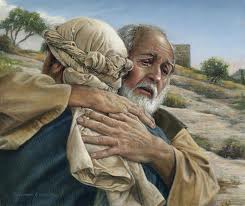
Jesus portrays the father as
waiting for his son, perhaps daily searching the distant road, hoping
for his appearance. The father notices him while he was still a long way
off. The father’s compassion assumes some knowledge of the son’s
pitiful state, possibly from reports sent home. During that time it was
not the custom of men to run, yet the father runs to greet his son (vs.20).
Why would he break convention for this wayward child who had sinned
against him? The obvious answer is because he loved him and was eager to
show him that love and restore the relationship. When the father
reaches his son, not only does he throw his arms around him, but he also
greets him with a kiss of love (1 Peter 5:14).
He is so filled with joy at his son’s return that he doesn’t even let
him finish his confession. Nor does he question or lecture him; instead,
he unconditionally forgives him and accepts him back into fellowship.
The father running to his son, greeting him with a kiss and ordering the
celebration is a picture of how our Heavenly Father feels towards
sinners who repent. God greatly loves us, patiently waits for us to
repent so he can show us His great mercy, because he does not want any
to perish nor escape as though by the fire (Ephesians 2:1-10; 2 Peter 3:9; 1 Corinthians 3:15).
This prodigal son was satisfied to
return home as a slave, but to his surprise and delight is restored
back into the full privilege of being his father’s son. He had been
transformed from a state of destitution to complete restoration. That is
what God’s grace does for a penitent sinner (Psalm 40:2; 103:4).
Not only are we forgiven, but we receive a spirit of sonship as His
children, heirs of God and co-heirs with Christ, of His incomparable
riches (Romans 8:16-17; Ephesians 1:18-19).
The father then orders the servants to bring the best robe, no doubt
one of his own (a sign of dignity and honor, proof of the prodigal’s
acceptance back into the family), a ring for the son’s hand (a sign of
authority and sonship) and sandals for his feet (a sign of not being a
servant, as servants did not wear shoes—or, for that matter, rings or
expensive clothing, vs.22). All these things represent what we receive in Christ upon salvation: the robe of the Redeemer’s righteousness (Isaiah 61:10), the privilege of partaking of the Spirit of adoption (Ephesians 1:5), and feet fitted with the readiness that comes from the gospel of peace, prepared to walk in the ways of holiness (Ephesians 6:15). A fattened calf is prepared, and a party is held (notice that blood was shed = atonement for sin, Hebrews 9:22). Fatted calves in those times were saved for special occasions such as the Day of Atonement (Leviticus 23:26-32).
This was not just any party; it was a rare and complete celebration.
Had the boy been dealt with according to the Law, there would have been a
funeral, not a celebration. “The Lord does
not treat us as our sins deserve or repay us according to our
iniquities. For as high as the heavens are above the earth, so great is
his love for those who fear him; as far as the east is from the west, so
far has he removed our transgressions from us. As a father has
compassion on his children, so the Lord has compassion on those who fear
him.” (Psalm 103:10-13).
Instead of condemnation, there is rejoicing for a son who had been dead
but now is alive, who once was lost but now is found (Romans 8:1; John 5:24).
Note the parallel between “dead” and “alive” and “lost” and
“found”—terms that also apply to one’s state before and after conversion
to Christ (Ephesians 2:1-5). This is a picture of what occurs in heaven over one repentant sinner (Luke 10).
Now to the final and tragic
character in the Parable of the Prodigal Son, the oldest son, who, once
again, illustrates the Pharisees and the scribes. Outwardly they lived
blameless lives, but inwardly their attitudes were abominable (Matthew 23:25-28).
This was true of the older son who worked hard, obeyed his father, and
brought no disgrace to his family or townspeople. It is obvious by his
words and actions, upon his brothers return, that he is not showing love
for his father or brother. One of the duties of the eldest son would
have included reconciliation between the father and his son. He would
have been the host at the feast to celebrate his brother’s return. Yet
he remains in the field instead of in the house where he should have
been. This act alone would have brought public disgrace upon the father.
Still, the father, with great patience, goes to his angry and hurting
son. He does not rebuke him as his actions and disrespectful address of
his father warrant (vs.29, “Look,” he says, instead of addressing him as “father” or “my lord”),
nor does his compassion cease as he listens to his complaints and
criticisms. The boy appeals to his father’s righteousness by proudly
proclaiming his own self-righteousness in comparison to his brother’s
sinfulness (Matthew 7:3-5). By saying, “This son of yours,” the older brother avoids acknowledging that the prodigal is his own brother (vs. 30). Just like the Pharisees, the older brother was defining sin by outward actions, not inward attitudes (Luke 18:9-14).
In essence, the older brother is saying that he was the one worthy of
the celebration, and his father had been ungrateful for all his work.
Now the one who had squandered his wealth was getting what he, the older
son, deserved. The father tenderly addresses his oldest as “my son” (vs. 31) and corrects the error in his thinking by referring to the prodigal son as “this brother of yours” (vs. 32). The father’s response, “We had to celebrate,”
suggests that the elder brother should have joined in the celebration,
as there seems to be a sense of urgency in not postponing the
celebration of the brother’s return.
The older brother’s focus was on
himself, and as a result there is no joy in his brother’s arrival home.
He is so consumed with issues of justice and equity that he fails to see
the value of his brother’s repentance and return. He fails to realize
that “anyone who claims to be in the light
but hates his brother is still in the darkness. Whoever loves his
brother lives in the light, and there is nothing in him to make him
stumble. But whoever hates his brother is in the darkness; he does not
know where he is going, because the darkness has blinded him” (1 John 2:9-11).
The older brother allows anger to take root in his heart to the point
that he is unable to show compassion towards his brother, and, for that
matter he is unable to forgive the perceived sin of his father against
him (Genesis 4:5-8).
He prefers to nurse his anger rather than enjoy fellowship with his
father, brother and the community. He chooses suffering and isolation
over restoration and reconciliation (Matthew 5:24; 6:14-15).
He sees his brother’s return as a threat to his own inheritance. After
all, why should he have to share his portion with a brother who has
squandered his? And why hadn’t his father rejoiced in his presence
through his faithful years of service?
The wise father seeks to bring
restoration by pointing out that all he has is and has always been
available for the asking to his obedient son, as it was his portion of
the inheritance since the time of the allotment. The older son never
utilized the blessings at his disposal (Galatians 5:22; 2 Peter 1:5-8).
This is similar to the Pharisees with their religion of good works.
They hoped to earn blessings from God and in their obedience merit
eternal life (Romans 9:31-33; 10:3).
They failed to understand the grace of God and failed to comprehend the
meaning of forgiveness. It was, therefore, not what they did that
became a stumbling block to their growth but rather what they did not do
which alienated them from God (Matthew 23:23-24, Romans 10:4). They were irate when Jesus was receiving and forgiving “unholy”
people, failing to see their own need for a Savior. We do not know how
this story ended for the oldest son, but we do know that the Pharisees
continued to oppose Jesus and separate themselves from His followers.
Despite the father’s pleading for them to “come in,” they refused and were the ones who instigated the arrest and crucifixion of Jesus Christ (Matthew 26:59). A tragic ending to a story filled with such hope, mercy, joy, and forgiveness.
The picture of the father
receiving the son back into relationship is a picture of how we should
respond to repentant sinners as well (1 John 4:20-21; Luke 17:3; Galatians 6:1; James 5:19-20). “All have sinned and fall short of the glory of God” (Romans 3:23). We are included in that “all,” and we must remember that “all our righteous acts are like filthy rags” apart from Christ (Isaiah 64:6; John 15:1-6). It is only by God’s grace that we are saved, not by works that we may boast of (Ephesians 2:9; Romans 9:16; Psalm 51:5). That is the core message of the Parable of the Prodigal Son.
Recommended Resource: Parables of Jesus by James Montgomery Boice.
http://brakeman1.com/2012/04/24/what-is-the-meaning-of-the-parable-of-the-prodigal-son/Tuesday, June 22, 2010
TATA -PE SCARA CERULUI URCA BINE SI REPEDE SAU URCA INCET SI GREU?
Ce asteapta tanarul de la tatal sau
Nu, nu cheile de la masina;iata cateva concluzii aparute in urma unui sondaj de opinie instrumentat de Youth Unlimited pe aceasta tema:El astepta ca tatal sa-l intrebe ce face, cum i-a fost ziua si apoi sa aiba timp sa primeasca raspunsul. Asta arata ca iti pasa de copil. 73% din tinerii canadieni au spus ca a avea pe cineva care sa-i asculte este foarte, foarte important.
El se astepta ca tatal sa fie constant si sustinut in exemplul si modelul – in setul de valori – pe care il ofera. Tatii au datoria de a invata standradul moral si setul de credinta. Tinerii sunt foarte sensibili la ipocrizie si urasc standardul dublu. Intr-o lume a minciunii ei au nevoie sa stie ca tatal lor le spune adevarul.
El vrea sa stie ca tatal il iubeste neconditional. Indiferent de cat de multe prostii fac tinerii au nevoie sa stie ca sunt iubiti. Copii vor sa vada si latura emotionala a celui care se ingrijeste de ei. Tatal nu este o aratare impersoanala venita din alta lume.
Fetele vor sa stie ca tatal lor le trateaza cu respect si verbal si fizic. Tatal seteaza valoarea si pretentia pe care fata o va avea de la viitorul ei partener de viata. Modul cum isi onoreaza sotia - ca fiinta, nu obiect – este la fel de important in deprinderea de catre fete a unui set corect de valori despre umanitatea ei.
Copii au nevoie in aceiasi masura si de calauzire si de libertate. Libertatea este castigata de copii in masura in care ei se dovedesc responsabili cu ceea ce au deja in jur.
Greu, usor, cand vom muri singurul lucru pe care il lasam dupa noi celor dragi este amintirea cum i-am iubit si pretuit. Daca mai primesc si ceva bani, cu atat mai bine; desi in conditiile exsitente se pare ca dupa moarte le vom lasa copiilor facturi de platit.
Sursa: Pe scara Cerului
Tatal - fisa de post
In NordAmerica este din nou celebrata Ziua Tatalui; prilej de analize si reanalizari…Traim intr-un timp si intr-o cultura in care importanta “tatalui”(rol, functie, postura) este depreciata. Intr-un fel putem accepta si faptul ca ne-am facut-o cu mana noastra prin departarea de forma(interioara) pe care Dumnezeu i-a conferit-o barbatului in momentul creatiei. Te departezi de masculinitate, te departezi si de ce inseamna a fi un tata normal.
Media nu se sfieste sa prezinte tatal precum o persoana cam prostutza, macinata de tot felul de controverse si pofte, tratandu-si neglijent sotia si copii – dar iubindu-i pe undeva, cumva.
Conectarea intre tata si copilul/copii sai este esentiala pentru formarea descendentilor. Popularitatea retelelor sociale arata “foamea” existenta in societate dupa relatii, dupa legaturi.
Cateva idei despre normalitatea existentei unui tata:
Tatal trebuie sa fie prezent; adica sa participe in viata copiilor sai in fiecare zi. Mama este un partener in ingrijirea copiilor nu cea care trebuei sa se ocupe de tot. Prezenta tatalui ii ajuta pe copii in formarea relatiilor cu cei aflati din jurul lor.
Tatal e bine sa fie coleg de joaca. Activitatile fizice sunt mult mai la indemna tatalui decat a mamei. Aici intra in discutie si forta muschilor si exersarea lor. De la o simpla harjoneala – cand sunt mici, la implicarea in adoelscenta in tot felul de activitati fizice – participarea impreuna cu copii la diferite sporturi(de echipa). Sportul este o buna sansa de a oferi lectii de viata.
Tatal transmite mai departe principii. Prin ceea ce face si spune, prin atitudine si maniera el este un ghid practic de formare a principiilor de viata (mai ales in zona morala). Copii au nevoie de directie, de ghidare in drumul pe care il au inaintea lor. Traiectoria se formeaza de acasa iar stabilirea ei inseamna uneori si perioada de disciplinare. Disciplinarea este legata de responsabilitate, caracter, obiceiuri. Disciplinarea are in vedere mai mult rasplatirea decat corectarea.
Unul din lucrurile pe care societatea nu le-a modificat este functia tatalui de a procura cele necesare vietii dpv material. Lipita de asta sta capcana de a crede ca daca copii tai au cu ce sa se imbrace si ce sa manace, nu mai au nevoie de tine. Ca rolul tau se rezuma aici si gata. Furnizarea de resurse nu este un lucru usor si nu este singurul lucru.
Tatal-Antrenor. Nu este vroba de sport, este vorba de pregatirea pentru probleme reale ale vietii. De exersarea adoptarii unor decizii impreuna. Mai nou media educa copii despre orice. Sfatul, intelepciunea si solutiile pe care un tata le poate da, sunt decisive si raman. A fi un cetatean responsabil nu este un joc al norocului. A sti pentru ce sa lupti si ce sa lasi sa treaca pe langa tine nu se invata doar dupa zeci de experinte triste.
Sursa: Pe scara Cerului
Atei fara tata...
In cartea The Making of an Atheist, James Spiegel, face o legatura interesanta intre ateism si absenta tatalui din familie.Desigur nu este o regula general valabila dar consistenta alaturarii celor doua elemente nu poate fi ignorata. Iata o lista a unor cunsocute persoanlitati care promoveaza ateismul/scepticismul si relatia/legatura pe care au avut-o cu tatal lor biologic:
David Hume: avea 2 ani cand tatal sau a murit;
Arthur Schopenhaur: avea 16 ani cand tatal sau a murit;
Friedrich Nietzsche: avea 4 ani cand tatal sau a murit;
Bertrand Russell: avea 4 ani cand tatal sau a murit;
Jean-Paul Sartre: avea numai 15 luni cand tatal sau a murit;
Albert Camus: avea 12 luni cand tatal sau a murit;
Daniel Dennet: a avut 5 ani cand tatal sau a murit.
Thomas Hobbes: avea 7 ani cand tatal si-a parasit familia;
Voltaire: a avut o relatie dura cu tatal sau, Arouet, si a fost renegat/dezmostenit;
Baron d’Holbach: a fost despartit de tatal sau si si-a sters numele acestuia dintre prenumele sale(Thiry);
Samuel Butler: a fost abuzat fizic si emotional de tatal sau;
Sigmund Frued: a avut un dispret pentru perversiunile sexuale ale tatalui sau;
H.G. Wells: i-a reprosat mereu tatalui sau faptul ca si-a neglijat familia;
Madalyn Murray O’Hair: si-a urat tatal intens;
Albert Ellis: a fost neglijat si abandonat de tatal sau;
Datele de mai sus nu sustin idea ca absenta tatalui inseamna automat (apartenenta la sau) promovarea ateismului. Dar justifica intr-un fel de ce acestia nu ii pot spune lui Dumnezeu, “Tata”.
Intr-un mod cert pot spune faptul ca tatal este provocat de invatatura biblica sa-l instruiasca, educe, protejeze, incurajeze si sa mearga alaturi de copilul sau.
Prea multi tati astazi nu sunt interesati decat de munca lor, femei, sanatate si timp liber.
Inaintea lui Dumnezeu s-ar putea sa nu fiu intrebat nici cat de mult greutati am ridicat la sala de fitness si nici ce model vechi de masina mi-am remodelat in garaj; dar sunt mari sanse sa fiu intrebat de copii mei…
Sursa: Pe scara cerului
Subscribe to:
Posts (Atom)