Showing posts with label Pharisees. Show all posts
Showing posts with label Pharisees. Show all posts
Friday, May 10, 2013


Thursday, March 28, 2013
PALM SUNDAY-HE JESUS SET HIS FACE TO GO TO JERUSALEM!
Palm Sunday – He (Jesus) set His face to go to Jerusalem!
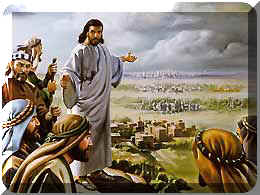
from Desiring God. You can listen to the audio for this John Piper sermon here.
Luke 9:51-56
Luke describes the arrival of Jesus in Jerusalem at the beginning of that last week of his earthly life:
As he was drawing near, at the descent of the Mount of Olives, the whole multitude of the disciples began to rejoice and praise God with a loud voice for all the mighty works that they had seen, saying, “Blessed is the King who comes in the name of the Lord! Peace in heaven and glory in the highest! (Luke 19:37, 38)
Palm Sunday: Today and To Come
There is no doubt what was in the disciples’ minds. This was the fulfillment of Zechariah’s prophecy given centuries earlier:
Rejoice greatly, O daughter of Zion! Shout aloud, O daughter of Jerusalem! Lo, your king comes to you; triumphant and victorious is he, humble and riding on an ass, on a colt, the foal of an ass. I will cut off the chariot from Ephraim and the war horse from Jerusalem, and the battle bow shall be cut off, and he shall command peace to the nations; his dominion shall be from sea to sea, and from the River to the ends of the earth. (Zechariah 9:9, 10)
The long-awaited Messiah had come, the king of Israel, and not just of Israel but of all the earth. Jerusalem would be his capital city. From here he would rule the world in peace and righteousness. What a day this was! How their hearts must have pounded in their chests! And must not their hands have been sweaty like warriors in readiness just before the bugle sounds the battle! How would he do it? Would he whip up the enthusiastic crowds and storm the Roman praetorium—a people’s revolution? Or would he call down fire from heaven to consume the enemies of God? Would any of his followers be lost in the struggle? The tension of the moment must have been tremendous!
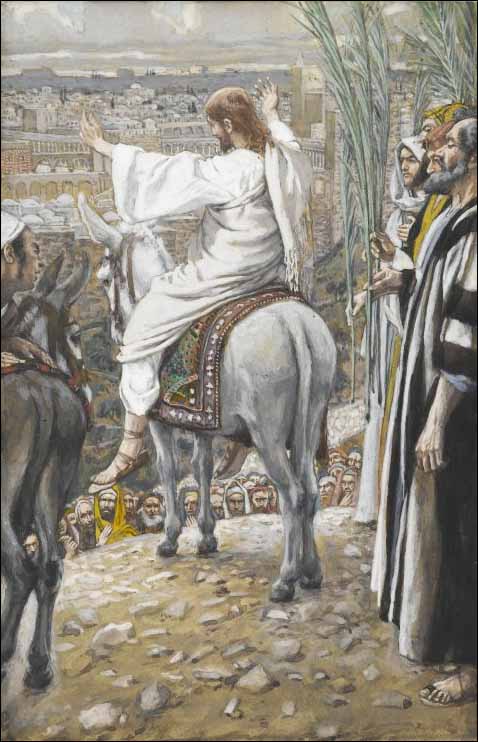 The
Pharisees had a double reason for wanting this kind of welcome
silenced. On the one hand, this Jesus was a threat to their authority,
and they envied his popularity (Mark 15:10). On the other hand, they feared a Roman backlash to all this seditious talk of another king (John 11:48). Therefore they say to Jesus, “‘Teacher, rebuke your disciples.’ But he answered, ‘I tell you, if these were silent, the very stones would cry out!”‘ (Luke 19:39, 40).
No, he will not rebuke them for this. Not now. The hour has come. The
authority of the Pharisees is done for. If the Romans come, they come.
He will not silence the truth any longer. To be sure the disciples’
understanding of Jesus’ kingship at this point is flawed. But hastening
events will correct that soon enough. In essence they are correct. Jesus
is the king of Israel, and the kingdom he is inaugurating will bring
peace to all the nations and spread from sea to sea. The book of
Revelation pictures the final fulfillment of Palm Sunday in the age to
come like this:
The
Pharisees had a double reason for wanting this kind of welcome
silenced. On the one hand, this Jesus was a threat to their authority,
and they envied his popularity (Mark 15:10). On the other hand, they feared a Roman backlash to all this seditious talk of another king (John 11:48). Therefore they say to Jesus, “‘Teacher, rebuke your disciples.’ But he answered, ‘I tell you, if these were silent, the very stones would cry out!”‘ (Luke 19:39, 40).
No, he will not rebuke them for this. Not now. The hour has come. The
authority of the Pharisees is done for. If the Romans come, they come.
He will not silence the truth any longer. To be sure the disciples’
understanding of Jesus’ kingship at this point is flawed. But hastening
events will correct that soon enough. In essence they are correct. Jesus
is the king of Israel, and the kingdom he is inaugurating will bring
peace to all the nations and spread from sea to sea. The book of
Revelation pictures the final fulfillment of Palm Sunday in the age to
come like this:
I looked and behold, a great multitude which no man could number, from every nation, from all tribes and peoples and tongues, standing before the throne and before the Lamb, clothed in white robes, with palm branches in their hands, and crying out with a loud voice, “Salvation belongs to our God who sits upon the throne, and to the Lamb!” (Revelation 7:9, 10)
The entry into Jerusalem with waving palms (John 12:13) was a short-lived preview of the eternal Palm Sunday to come. It needed to be said. If the disciples hadn’t said it, the rocks would have.
I like to think of all our worship in this age as rehearsal for the age to come. One day we, who by God’s grace have been faithful to the Lord, are going to stand with innumerable millions of believers from Bangladesh, Poland, Egypt, Australia, Iceland, Cameroon, Ecuador, Burma, Borneo, Japan, and thousands of tribes and peoples and languages purified by Christ, with palms of praise in our hand. And when we raise them in salute to Christ, He will see an almost endless field of green, shimmering with life and pulsating with praise. And then like the sound of a thousand Russian choruses, we will sing our song of salvation, while the Mighty Christ, with heartfelt love, looks out over those whom he bought with his own blood.
Had Jesus taken his throne on that first day of palms, none of us would ever be robed in white or waving palms of praise in the age to come. There had to be the cross, and that is what the disciples had not yet understood. Back in Luke 9, as Jesus prepared to set out for Jerusalem from Galilee, he tried to explain this to his disciples. In verse 22 he said, “The Son of Man must suffer many things, and be rejected by the elders and chief priests and scribes, and be killed, and on the third day be raised.” And in verse 44 he told them, “Let these words sink into your ears; for the Son of Man is to be delivered into the hands of men.” But verse 45 tells us, “They did not understand this saying, and it was concealed from them that they should not perceive it; and they were afraid to ask him about this saying.” Therefore, their understanding of Jesus’ last journey to Jerusalem was flawed. They saw him as a king moving in to take control. And he was. But they could not grasp that the victory Jesus would win in Jerusalem over sin and Satan and death and all the enemies of righteousness and joy—that this victory would be won through his own horrible suffering and death; and that the kingdom which they thought would be established immediately (Luke 19:11) would, in fact, be thousands of years in coming. And their misunderstanding of Jesus’ journey to Jerusalem results in a misunderstanding of the meaning of discipleship. This is why this is important for us to see, lest we make the same mistake.
Jesus’ Resolution to Die
In Luke 9:51–56 we learn how not to understand Palm Sunday. Let’s look at it together. “When the days drew near for him to be received up, he set his face to go to Jerusalem.” To set his face towards Jerusalem meant something very different for Jesus than it did for the disciples. You can see the visions of greatness that danced in their heads in verse 46: “An argument arose among them as to which of them was the greatest.” Jerusalem and glory were just around the corner. O what it would mean when Jesus took the throne! But Jesus had another vision in his head. One wonders how he carried it all alone and so long. Here’s what Jerusalem meant for Jesus: “I must go on my way today and tomorrow and the day following; for it cannot be that a prophet should perish away from Jerusalem”(Luke 13:33). Jerusalem meant one thing for Jesus: certain death. Nor was he under any illusions of a quick and heroic death. He predicted in Luke 18:31f., “Behold, we are going up to Jerusalem, and everything that is written of the Son of man by the prophets will be accomplished. For he will be delivered to the Gentiles, and will be mocked and shamefully treated and spit upon; they will scourge him and kill him.” When Jesus set his face to go to Jerusalem, he set his face to die.
Remember, when you think of Jesus’ resolution to die, that he had a nature like ours. He shrunk back from pain like we do. He would have enjoyed marriage and children and grandchildren and a long life and esteem in the community. He had a mother and brothers and sisters. He had special places in the mountains. To turn his back on all this and set his face towards vicious whipping and beating and spitting and mocking and crucifixion was not easy. It was hard. O how we need to use our imagination to put ourselves back into his place and feel what he felt. I don’t know of any other way for us to begin to know how much he loved us. “Greater love has no man than this, that a man lay down his life for his friends” (John 15:13).
If we were to look at Jesus’ death merely as a result of a betrayer’s deceit and the Sanhedrin’s envy and Pilate’s spinelessness and the soldiers’ nails and spear, it might seem very involuntary. And the benefit of salvation that comes to us who believe from this death might be viewed as God’s way of making a virtue out of a necessity. But once you read Luke 9:51 all such thoughts vanish. Jesus was not accidentally entangled in a web of injustice. The saving benefits of his death for sinners were not an afterthought. God planned it all out of infinite love to sinners like us and appointed a time. Jesus, who was the very embodiment of his Father’s love for sinners, saw that the time had come and set his face to fulfill his mission: to die in Jerusalem for our sake. “No one takes my life from me (he said), but I lay it down of my own accord” (John 10:18).
Jesus’ Journey Is Our Journey
So Jesus sets out for Jerusalem, and it says in the text that “he sent messengers ahead of him, who went and entered a village of the Samaritans to make ready for him; but the people would not receive him because his face was set toward Jerusalem.” It doesn’t really matter whether this rejection is just because Jesus and his companions are Jews and Samaritans hate Jews, or whether the rejection is a more personal rejection of Jesus as the Messiah on his way to reign in Jerusalem. What matters for the story is simply that Jesus is already being rejected, and then the focus shifts to the disciples’ response, specifically the response of James and John.
James and John ask Jesus, “Lord, do you want us to bid fire to come down from heaven and consume them?” (verse 54). Jesus had already named these brothers “sons of thunder” (Mark 3:17). Here we get a glimpse of why. I take this passage very personally because my father named me after one of these sons of thunder. And I think I probably would have said what John did here: “Jesus, we are on the way to victory. Nothing can stop us now. Let the fire fall! Let the judgment begin! O, how Jerusalem will tremble when they see us coming!” Jesus turns, the text says, and rebuked them (verse 55). And they simply went to another town.
Now what does this mean? It means, first of all, that a mistaken view of Jesus’ journey to Jerusalem can lead to a mistaken view of discipleship. If Jesus had come to execute judgment and take up an earthly rule, then it would make sense for the sons of thunder to begin the judgment when the final siege of the Holy City starts. But if Jesus had come not to judge but to save, then a radically different form of discipleship is in order. Here is a question put to every believer by this text: does discipleship mean deploying God’s missiles against the enemy in righteous indignation? Or does discipleship mean following him on the Calvary road which leads to suffering and death? The answer of the whole New Testament is this: the surprise about Jesus the Messiah is that he came to live a life of sacrificial, dying service before he comes a second time to reign in glory. And the surprise about discipleship is that it demands a life of sacrificial, dying service before we can reign with Christ in glory.
What James and John had to learn—what we all must learn—is that Jesus’ journey to Jerusalem is our journey, and if he set his face to go there and die, we must set our face to die with him. One might be tempted to reason in just the opposite way: that since Jesus suffered so much and died in our place, therefore, we are free to go straight to the head of the class, as it were, and skip all the exams. He suffered so we could have comfort. He died so we could live. He bore abuse so we could be esteemed. He gave up the treasures of heaven so we could lay up treasures on earth. He brought the kingdom and paid for our entrance and now we live in it with all its earthly privileges. But all this is not biblical reasoning. It goes against the plain teaching in this very context. Luke 9:23, 24 reads: “If any man would come after me, let him deny himself and take up his cross daily and follow me. For whoever would save his life will lose it; and whoever loses his life for my sake, he will save it.” When Jesus set his face to walk the Calvary road, he was not merely taking our place; he was setting our pattern. He is substitute and pacesetter. If we seek to secure our life through returning evil for evil or surrounding ourselves with luxury in the face of human need, we will lose our life. We can save our life only if we follow Christ on the Calvary road. Jesus died to save us from the power and punishment of sin, not from the suffering and sacrifices of simplicity for love’s sake.
By John Piper. © Desiring God. Website: desiringGod.org
24 Mar 2013
Reblogged from rodi in http://rodiagnusdei.wordpress.com/2013/03/24/b-palm-sunday-23-he-jesus-set-his-face-to-go-to-jerusalem-palm-sunday/Bible Study, Christ, Jesus Christ, Salvation, Word of God
Related articles
- The Jewish Roots of Palm Sunday and the Passion (thesacredpage.com)
- 9 things you need to know about Palm Sunday (ncregister.com)
- Carissimi; Sunday’s Mass: Palm Sunday (frjeromeosjv.wordpress.com)
- Palm/Passion Sunday: Mar. 24 (prayerscapes.wordpress.com)
- Palm Sunday (givemeliberty01.com)
- Christians Celebrate Palm Sunday (voanews.com)
- Do you know what time it is? (tithebarn.wordpress.com)
- Palm Sunday (kenarah.wordpress.com)
- Palm Sunday Eve (ministersjourney.wordpress.com)
- What You Need to Know about Palm Sunday (theriverbankchicago.wordpress.com)
Thursday, January 31, 2013
FALSE DOCTRINE -VERSUS GOOD DOCTRINE ABOUT JOY – Martyn Lloyd-Jones,John Piper

You can listen to the 5 min. podcast here- https://soundcloud.com

John Piper (theologian) (Photo credit: Wikipedia)
The famous preacher Martyn Lloyd-Jones, in a sermon on Philippians, said, “False doctrine makes joy in the Lord impossible.” Pastor John, how would you articulate this connection between orthodoxy and joy? How does false doctrine make joy in the Lord impossible?
John Piper:
The key in that phrase is “in the Lord”. Joy in the Lord. False doctrine can make you very happy. If you don’t believe in hell, you might feel happier. If you don’t believe that you don’t have to not sleep around in the weekends and cheat on your wife, then you might have some brief surges of pleasure.
But, when he (Dr. Martyn Lloyd-Jones) says false doctrine makes joy in the Lord impossible, he’s articulating something really important, namely: The only joy that glorifies God is joy that based on a true view of God. If you have happiness because you see God the way He’s not, you might have happiness based on your doctrine, but your doctrine is false and God would not be honored by your happiness. It would be like a person who is thrilled- he’s watching his favorite football team and they’ve just crossed the goal line. And, “Yeah! Yeah!” he’s cheering his lungs out, when he realizes he ran the wrong way. He’s crossed the wrong goal line. He didn’t make 6 points, he lost. And so, that cheering isn’t honoring the team. It makes a fool out of the team.
So, false doctrine presents God, or His ways in a way that they’re not. And if we are happy by what God is not, then He’s not honored by our happiness. And so, right doctrine is in fact a way of showing God and His ways as they really are, so that our joy can be in what is and then our joy is an honor to God. And God is most glorified in us when we are most satisfied in Him. I don’t often say, but, I should say more often probably, that when I say that, that “God is most glorified in us when we are most satisfied in Him”, it presumes that the God in whom we are satisfied is the true God. That we have true views of Him. And so, false views of God will prevent joy in the true God, and that’s the only joy that honors God.
Clearly, if you have a wrong view of salvation, you lose your joy forever. And that’s what was happening in the book of Galatians. They knew God, the Pharisees knew God, and Jesus said, “You’re children of hell, and you’re going there because your view of how to relate to God is upside down.” You think that God is impressed by your works for Him and that you can put Him in your debt. And you can’t. And Christians are those who bring a Gospel like that, so Paul says, “All happiness vanishes.” And that’s probably what Martyn Lloyd-Jones meant. All happiness is going to melt for those who follow a false Gospel.
I have been criticized sometimes for being a hedonist, a Christian hedonist because historic hedonism has often meant “pleasure becomes the criteria of what is right.” You discern what is right by what makes you happy. That’s never, ever been what I meant by hedonism. All I meant by Christian hedonism is “you are living to maximize your pleasure forever.” And that’s the biblical sense of why it’s right to pursue your happiness. But yes, we must be very suspicious of making our pleasures the criteria of what is right or holy, or good, or true. You do it the other way around.
You let the Bible decide what’s true, and then you labor to submit your heart to that so that you can find happiness in the truth, not determine what is true by what makes you happy.
30 Jan 2013Reblogged from rodi
http://rodiagnusdei.wordpress.com/2013/01/30/why-false-doctrine-can-make-you-happy/

Monday, July 9, 2012
HEART OF STONE
Heart of stone
08 Jul 2012

photo via http://www.sermoncentral.com
Ezekiel 11:19 I will give them an undivided heart and put a new spirit in them; I will remove from them their heart of stone and give them a heart of flesh.
Ezekiel 36:26 I will give you a new heart and put a new spirit in you; I will remove from you your heart of stone and give you a heart of flesh.
“Removing the Heart of Stone”
by Jason Cole via http://www.sermoncentral.com/sermons/removing-the-heart-of-stone-jason-cole:
In Psalms 139, David prayed, search me, O God, and know my heart; test me and know my anxious thoughts, see if there is any offensive way in me, and lead me in the way everlasting. David’s prayer was essentially for God to reveal his faults and innermost inadequacies. I don’t believe that David was praying for the Lord to reveal his faults though, because he was overly excited by his own falleness. He wanted God to reveal to him the faults even of his heart to help him to correct the problem. That would give him a place to start.
 Jesus
was really hard on the Pharisees, and the main reason was because of
their hardened stone hearts. It blows me away how people that possessed s
much knowledge about God, and a people that did so much in the name of
God, could have hearts as hard as they did. The Pharisees had hearts of
stone. They could find joy in the disgrace of a woman caught in the act
of adultery and take pride in the fulfillment of the law to stone her to
death. They could look at the situations of Jesus doing good and find
fault in them. Their hearts were made of stone.
The hard hearted are not always the easiest to identify however. Just
because a person is doing certain things that we think are good does not
guarantee that their heart is not stone. Just because you come to
church does not mean that your heart is not stone. Just because you read
your Bible and pray does not mean that your heart is not stone. Just
because you don’t drink, chew or go with girls who do does not mean that
your heart is not hard. In fact, it was the people that were doing
those things is Jesus’ day that he accused of having hard hearts made of
stone.
Jesus
was really hard on the Pharisees, and the main reason was because of
their hardened stone hearts. It blows me away how people that possessed s
much knowledge about God, and a people that did so much in the name of
God, could have hearts as hard as they did. The Pharisees had hearts of
stone. They could find joy in the disgrace of a woman caught in the act
of adultery and take pride in the fulfillment of the law to stone her to
death. They could look at the situations of Jesus doing good and find
fault in them. Their hearts were made of stone.
The hard hearted are not always the easiest to identify however. Just
because a person is doing certain things that we think are good does not
guarantee that their heart is not stone. Just because you come to
church does not mean that your heart is not stone. Just because you read
your Bible and pray does not mean that your heart is not stone. Just
because you don’t drink, chew or go with girls who do does not mean that
your heart is not hard. In fact, it was the people that were doing
those things is Jesus’ day that he accused of having hard hearts made of
stone.
Perhaps today we you can make a diagnosis about the condition of your heart and the good news is that the problem is treatable and there is a cure that exists.
1. Lost Compassion for the sick, hurting and sinner
One of the symptoms of a heart of stone is
a loss of compassion. One of the earmarks of our faith is the
compassion that we should have for other people. There have been times
in my life where I know I have been stone hearted to the sick and the
sinner. There have been times that I have passed by people that were in
need of love and compassion, and I walked by unmoved. I have had periods
in life where my heart was stone. Perhaps you can identify with me
here. How do you feel when you see a person that cannot afford to buy
their own food? Do you think to yourself that they are getting what they
deserve, or that they should get a job and stop asking for handouts?
The truth is, that is not how we have been called to view people and
that is not how Jesus viewed people. Sometimes I respond like that, but
that is revealing of a stone heart. Sometimes I am more zealous for
justice to be served and people to get what they deserve than I am for
people to receive grace and mercy. That is indicative of a stone heart.
Perhaps some of you can identify with me. How do you feel when you
learn that a brother or sister in Christ is living in sin? Do you
respond hoping that judgment will be served on them? Perhaps today you
have lost your sense of compassion on the hurting. How do you respond to
sinner’s coming to Christ? Do you think that you’ll have to wait around
for this person to be dunked? Do you still have a passion for what is
going on around the world? Our hearts should break over the very things that break the heart of God and we should be moved to action.
2. Lost Desire to Grow and do God’s will
As Christians we are in the process of
being changed and transformed into the image of God. Over time, however,
many loose their desire to continue to grow in their faith and to do
God’s will. It is when we stop growing and stop caring to grow that we
can tell that our hearts have become callused. Often times it is our own
conscious choices which create opportunities for our own spiritual
maturity. When we stop caring to create those opportunities we know that
our hearts are hardening.
The Dictionary defines apathy as a lack of
interest or concern, especially regarding matters of general importance
or appeal; indifference. A lack of emotion or feeling.
People with a stone heart are apathetic. They do not care about spiritual growth; they are perfectly content where they are in life. Someone once told a teenager that the greatest problem he faced was complacency. He responded, “Who cares?” People with stone hearts think that they are okay because of their pas victories, because of how spiritual they used to be or how faithful they once were, but they are forgetful of what their heart condition is now. Perhaps, you have lost your desire to grow, perhaps you are apathetic toward learning God’s Word. Perhaps you long for excuses to miss church or Sunday school, perhaps your heart has turned to stone. Some have the attitude of who cares, or they don’t need to grow, learn or conform more into God’s image. If so it needs to be chiseled away at.
3. Lost Excitement in the work of God
Another way to diagnose a stone heart is
when one looses excitement in the work of God. Christians should be
excited about hearing stories of victory in the kingdom, of souls be
saved, of lived being changed. Christians should be excited to serve God
and to be used by Him. Perhaps today you can diagnose a heart of stone.
Please know that softening your heart begins by slowly chiseling away at a stone heart.
II. How do our hearts turn to stone?

1. The Continued Practice of Sin Hardens the Heart
One thing that will harden a person’s
heart faster than anything else is the continued practice of sin.
Despite what many people will tell you, it really does matter what you
do and how you act. Sin is unique in that it usually leads to more.
Usually sin starts out with something small and grows and matures into
something bigger. There is an old saying that says:
Sow a thought reap a deed
Sow a deed reap a habit
Sow a habit reap a judgment
James 1:13-15
The reality is that we are all sinners. We
all have sinned and fallen short of the glory of God, but the Scripture
makes a clear separation between sinning and the continued practice of
sin. Sin is just a part of life, it is not justified and sin is wrong,
and we need to strive to avoid sin, but it is the continued practice of
sin, or a sinful lifestyle that hardens the heart. Perhaps today you
have stayed coming to church, but have been living in a state of sin.
Perhaps it is sin that no one knows about and you have kept hidden.
Perhaps you have been putting on a front and everyone thinks that you
are really righteous. Let me assure you that God knows every thought and
action and one day sin will be uncovered and revealed by God. Perhaps
you haven’t thought it was a very big deal, but let me tell you that sin
is a big deal because it violates the nature of God. The main trait
that we learn about God in the Bible is not his love or grace, but
rather his holiness. Sin violates the holiness of God and we with sin
cannot come into God’s presence. Sin brings about the wrath of God
because He is holy. Because of sin we will all encounter God’s wrath, we
will face it either at judgment or we will encounter God’s wrath on the
cross where Jesus bore our sin and the wrath of God. The Scripture says
that God made him who knew no sin to become sin for us so that we might
know the righteousness of God. Perhaps today you have been living in
constant unrepented sin and haven’t thought it a big deal and you’ve
thought that it was okay to sin because God will forgive you. It is sin
that hardens the heart.
a. Our World’s Standards are not necessarily God’s standards
Our world has tried to teach us what is
right and wrong. Many in the church have bought into the lie that if it
is accepted by the world that it is accepted by God, but the world’s
standards are not necessarily God’s standards.
Ezekiel 11:12
I want you to know plainly that sin is a big deal essentially because of what you are saying when you are living in a constant state of sin. One of the speakers at camp said that sin is us essentially saying that we want to kill God and take his place on the throne. I think that is true when you take sin to its next logical step. Sin is violating the law of God and us saying that we do not have to submit to the authority of God. Sin is a big deal and it is sin that separates us from God. I want you to be aware that the continued practice of sin hardens the heart to stone. I want to encourage you if you are living in sin, repent, and don’t live in it any longer. The continued practice of sin will magnify into greater sin and eventually a hardened heart.
2. The Removal From God’s Presence and People Hardens the Heart
I love to watch a good fire burn. To me it
is really cool to watch how when you put a bunch of logs together they
can make a huge flame. When I would go to camp we would make the largest
fires that were possible. One thing about those fires is that when you
remove one log from the group of logs, that fire soon dies out in the
one removed. It is the same with us when we are away from the presence
of God and His people. A lot of people put any and everything before
attending church, but let me assure you one quick way to turn your heart
to stone is to stay out of the church. Missing just a few times will
make one calloused and hardened. The Scriptures teach that as iron
sharpens iron, so one man sharpens another. The Fellowship God’s people is important and missing church, the removal from God’s presence and people hardens the heart.
III. How do we Soften Stone Hearts?
Maybe today you sit here and you realize maybe your heart has turned to stone. Maybe you are wondering what you can do for your heart to be made soft again. I want to tell you that it begins by chiseling away at the stone. Many things may have come into your life and slowly hardened your heart, today you can chisel away at that heart of stone.
1. The Spirit of God Chisels Away at Hard Hearts
 One
of the roles of the Holy Spirit is to bring conviction to people’s
hearts. It was the Holy Spirit working on the hearts of the Jews on
Pentecost when they said, they were pierced to the heart. Perhaps today
the Spirit is working on your hearts and bringing conviction through the
Word of God, if so I hope that the conviction you may feel will be
taken as a message from God. People respond all sorts of ways when they
feel convicted. Some people push it off and take it as nothing. Other
people heed that conviction and are thankful that God has revealed to
them the errors of their ways. Maybe the Spirit of God is trying to chisel away at your heart of stone.
One
of the roles of the Holy Spirit is to bring conviction to people’s
hearts. It was the Holy Spirit working on the hearts of the Jews on
Pentecost when they said, they were pierced to the heart. Perhaps today
the Spirit is working on your hearts and bringing conviction through the
Word of God, if so I hope that the conviction you may feel will be
taken as a message from God. People respond all sorts of ways when they
feel convicted. Some people push it off and take it as nothing. Other
people heed that conviction and are thankful that God has revealed to
them the errors of their ways. Maybe the Spirit of God is trying to chisel away at your heart of stone.
2. The Word of God Chisels Away at Hard Hearts
The Word of God is one of the most
powerful things that there is. It is the Word of God that is called the
sword of the Spirit and is our weapon against the Devil. The Word of God
tells us what it is that God expects of us. We learn right from wrong
and we learn God’s standard. We can learn in His Word where we are not
living up to what God expects. It is in the Word of God that we can find
help for our problems, we can claim promises that God gives us, we can
learn the way of chiseling away at our hearts.
3. The Fellowship of the Saints Chisels Away at Hard Hearts
The fellowship of the saints, of God’s
people is one of the greatest remedies for the hard heart. There is
something special about gathering in fellowship that has a away of
softening the heart. If your heart is hard one of the best things you
can do is consciously make a choice to be where God’s people are, find
opportunities to fellowship. Today, perhaps by being with God’s people
your heart is being chiseled away at.
4. The Guarding of our Hearts Chisels Away at Hard Hearts
I believe another way that our hearts are
softened and chiseled away at is by being careful what we allow into our
hearts. Jesus taught plainly, that t really does matter what you allow
into your hearts, because that goes to your heart and eventually will
come out.
Proverbs 4:23
Perhaps, you need to guard your heart and
remove some things from your way so that you are not polluting your mind
and heart. By guarding your heart and keeping yourself clear from
impure things you can chisel away at your hard heart.
5. The Repentance of Sin Chisels Away at Hard Hearts
The best way to soften a hard heart is
through repentance of sin. It is through repentance that we have the
promise of wipping our slates clean and being made right. We have the
promise of forgiveness of sins.
I John 1:9
Perhaps today your heart has become hard. I
want to encourage you today to repent of that sin that had held you
back from God. Repentance is not just being sorry for the sins that you
have committed though, it is a change in the lifestyle for the better.
Related articles
- Heart of stone (rodiagnusdei.wordpress.com)
- Heart of Stone (lisagobrien.com)
- Stone Y Hearts (diligentprojects5.wordpress.com)
Subscribe to:
Posts (Atom)


 Posts
Posts