Christianity can be condensed into four words: Admit, Submit, Commit and Transmit. -Samuel Wilberforce
Astăzi se împlinesc 500 de ani de la afișarea celor 95 de afirmații elaborate de Luther. N-au fost bătute în cuie în sensul unei ofense adresate bisericii, ci au fost puse acolo pentru că acesta era modul în care se făceau cunoscute astfel de lucruri în acea vreme. Tensiunea acelei zile a fost mult mai mică decît ne fac filmele sau diferitele narațiuni, fie și ale unor istorici romantico-isterici, să credem.
Afirmațiile au fost publicate în latină. Titlul inițial a fost Disputatio pro declaratione virtutis indulgentiarum. Abia traducerea tezelor în germană și vulgarizarea lor (atît în sens etimologic – coborîrea la vulg (popor), dar și vulgarizarea lor hermenutică) a generat apoi răspîndirea acestora și aprinderea miriștii deja uscate a Reformei.
Vulgarizarea însemna inițial popularizare. Din păcate, ambele procese s-au întîmplat și popularizarea și vulgarizarea, manipularea unor afirmații pentru a crea și mai multă tensiune.
Puțini au citit pînă la capăt cele 95 de teze și unele dintre acestea, fără cunoașterea contextului istoric și eclesial, sînt astăzi complet irelevante.
Iată cum va fi arătat documentul (foarte probabil):
apasă link-ul pentru a descărca documentul într-un format lizibil.
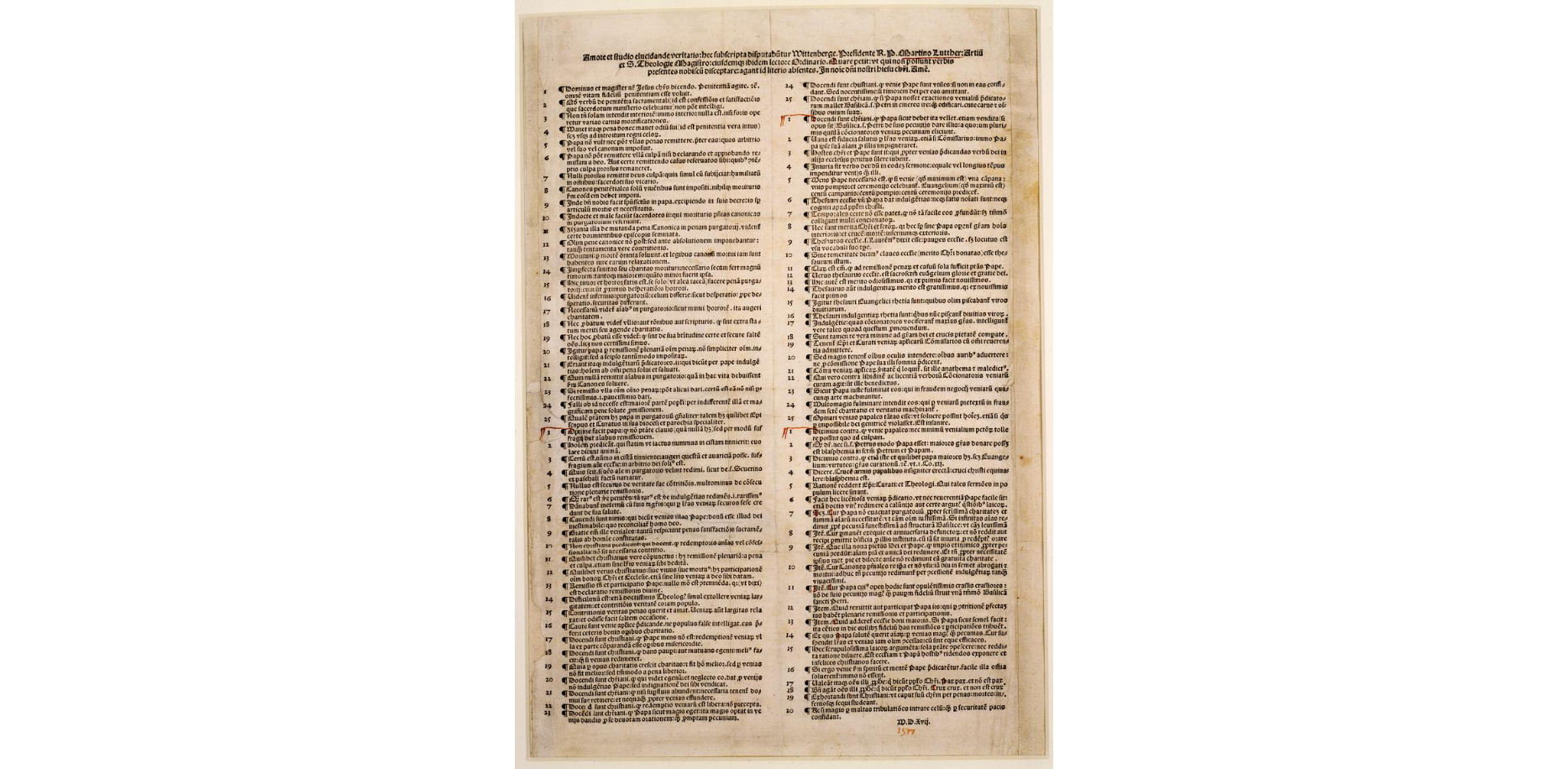
și textul latinesc:
LATIN TEXT
“Disputatio pro Declaratione Virtutis Indulgentiarum.”
by Dr. Martin Luther, 1483-1546
D. MARTIN LUTHERS WERKE: KRITISCHE GESAMMTAUSGABE.
1. Band (Weimar: Hermann Boehlau, 1883). pp. 233-238.
PW #001-001La
by Dr. Martin Luther, 1483-1546
D. MARTIN LUTHERS WERKE: KRITISCHE GESAMMTAUSGABE.
1. Band (Weimar: Hermann Boehlau, 1883). pp. 233-238.
PW #001-001La
Amore et studio elucidande veritatis hec subscripta disputabuntur
Wittenberge, Presidente R. P. Martino Lutther, Artium et S.
Theologie Magistro eiusdemque ibidem lectore Ordinario. Quare
petit, ut qui non possunt verbis presentes nobiscum disceptare
agant id literis absentes. In nomine domini nostri Hiesu Christi.
Amen.
Wittenberge, Presidente R. P. Martino Lutther, Artium et S.
Theologie Magistro eiusdemque ibidem lectore Ordinario. Quare
petit, ut qui non possunt verbis presentes nobiscum disceptare
agant id literis absentes. In nomine domini nostri Hiesu Christi.
Amen.
1. Dominus et magister noster Iesus Christus dicendo `Penitentiam
agite &c.’ omnem vitam fidelium penitentiam esse voluit.
agite &c.’ omnem vitam fidelium penitentiam esse voluit.
2. Quod verbum de penitentia sacramentali (id est confessionis et
satisfactionis, que sacerdotum ministerio celebratur) non potest
intelligi.
satisfactionis, que sacerdotum ministerio celebratur) non potest
intelligi.
3. Non tamen solam intendit interiorem, immo interior nulla est,
nisi foris operetur varias carnis mortificationes.
nisi foris operetur varias carnis mortificationes.
4. Manet itaque pena, donec manet odium sui (id est penitentia
vera intus), scilicet usque ad introitum regni celorum.
vera intus), scilicet usque ad introitum regni celorum.
5. Papa non vult nec potest ullas penas remittere preter eas, quas
arbitrio vel suo vel canonum imposuit.
arbitrio vel suo vel canonum imposuit.
6. Papa non potest remittere ullam culpam nisi declarando, et
approbando remissam a deo Aut certe remittendo casus reservatos
sibi, quibus contemptis culpa prorsus remaneret.
approbando remissam a deo Aut certe remittendo casus reservatos
sibi, quibus contemptis culpa prorsus remaneret.
7. Nulli prorus remittit deus culpam, quin simul eum subiiciat
humiliatum in omnibus sacerdoti suo vicario.
humiliatum in omnibus sacerdoti suo vicario.
8. Canones penitentiales solum viventibus sunt impositi nihilque
morituris secundum eosdem debet imponi.
morituris secundum eosdem debet imponi.
9. Inde bene nobis facit spiritussanctus in papa excipiendo in
suis decretis semper articulum mortis et necessitatis.
suis decretis semper articulum mortis et necessitatis.
10. Indocte et male faciunt sacerdotes ii, qui morituris
penitentias canonicas in purgatorium reservant.
penitentias canonicas in purgatorium reservant.
11. Zizania illa de mutanda pena Canonica in penam purgatorii
videntur certe dormientibus episcopis seminata.
videntur certe dormientibus episcopis seminata.
12. Olim pene canonice non post, sed ante absolutionem
imponebantur tanquam tentamenta vere contritionis.
imponebantur tanquam tentamenta vere contritionis.
13. Morituri per mortem omnia solvunt et legibus canonum mortui
iam sunt, habentes iure earum relaxationem.
iam sunt, habentes iure earum relaxationem.
14. Imperfecta sanitas seu charitas morituri necessario secum fert
magnum timorem, tantoque maiorem, quanto minor fuerit ipsa.
magnum timorem, tantoque maiorem, quanto minor fuerit ipsa.
15. Hic timor et horror satis est se solo (ut alia taceam) facere
penam purgatorii, cum sit proximus desperationis horrori.
penam purgatorii, cum sit proximus desperationis horrori.
16. Videntur infernus, purgaturium, celum differre, sicut
desperatio, prope desperatio, securitas differunt.
desperatio, prope desperatio, securitas differunt.
17. Necessarium videtur animabus in purgatorio sicut minni
horrorem ita augeri charitatem.
horrorem ita augeri charitatem.
18. Nec probatum videtur ullis aut rationibus aut scripturis, quod
sint extra statum meriti seu augende charitatis.
sint extra statum meriti seu augende charitatis.
19. Nec hoc probatum esse videtur, quod sint de sua beatitudine
certe et secure, saltem omnes, licet nos certissimi simus.
certe et secure, saltem omnes, licet nos certissimi simus.
20. Igitur papa per remissionem plenariam omnium penarum non
simpliciter omnium intelligit, sed a seipso tantummodo
impositarum.
simpliciter omnium intelligit, sed a seipso tantummodo
impositarum.
21. Errant itaque indulgentiarum predicatores ii, qui dicunt per
pape indulgentias hominem ab omni pena solvi et salvari.
pape indulgentias hominem ab omni pena solvi et salvari.
22. Quin nullam remittit animabus in purgatorio, quam in hac vita
debuissent secundum Canones solvere.
debuissent secundum Canones solvere.
23. Si remissio ulla omnium omnino penarum potest alicui dari,
certum est eam non nisi perfectissimis, i.e. paucissimis, dari.
certum est eam non nisi perfectissimis, i.e. paucissimis, dari.
24. Falli ob id necesse est maiorem partem populi per
indifferentem illam et magnificam pene solute promissionem.
indifferentem illam et magnificam pene solute promissionem.
25. Qualem potestatem habet papa in purgatorium generaliter, talem
habet quilibet Episcopus et Curatus in sua diocesi et parochia
specialiter.
habet quilibet Episcopus et Curatus in sua diocesi et parochia
specialiter.
1. [26] Optime facit papa, quod non potestate clavis (quam nullam
habet) sed per modum suffragii dat animabus remissionem.
habet) sed per modum suffragii dat animabus remissionem.
2. [27] Hominem predicant, qui statim ut iactus nummus in cistam
tinnierit evolare dicunt animam.
tinnierit evolare dicunt animam.
3. [28] Certum est, nummo in cistam tinniente augeri questum et
avariciam posse: suffragium autem ecclesie est in arbitrio dei
solius.
avariciam posse: suffragium autem ecclesie est in arbitrio dei
solius.
4. [29] Quis scit, si omnes anime in purgatorio velint redimi,
sicut de s. Severino et Paschali factum narratur.
sicut de s. Severino et Paschali factum narratur.
5. [30] Nullus securus est de veritate sue contritionis,
multominus de consecutione plenarie remissionis.
multominus de consecutione plenarie remissionis.
6. [31] Quam rarus est vere penitens, tam rarus est vere
indulgentias redimens, i. e. rarissimus.
indulgentias redimens, i. e. rarissimus.
7. [32] Damnabuntur ineternum cum suis magistris, qui per literas
veniarum securos sese credunt de sua salute.
veniarum securos sese credunt de sua salute.
8. [33] Cavendi sunt nimis, qui dicunt venias illas Pape donum
esse illud dei inestimabile, quo reconciliatur homo deo.
esse illud dei inestimabile, quo reconciliatur homo deo.
9. [34] Gratie enim ille veniales tantum respiciunt penas
satisfactionis sacramentalis ab homine constitutas.
satisfactionis sacramentalis ab homine constitutas.
10. [35] Non christiana predicant, qui docent, quod redempturis
animas vel confessionalia non sit necessaria contritio.
animas vel confessionalia non sit necessaria contritio.
11. [36] Quilibet christianus vere compunctus habet remissionem
plenariam a pena et culpa etiam sine literis veniarum sibi
debitam.
plenariam a pena et culpa etiam sine literis veniarum sibi
debitam.
12. [37] Quilibet versus christianus, sive vivus sive mortuus,
habet participationem omnium bonorum Christi et Ecclesie etiam
sine literis veniarum a deo sibi datam.
habet participationem omnium bonorum Christi et Ecclesie etiam
sine literis veniarum a deo sibi datam.
13. [38] Remissio tamen et participatio Pape nullo modo est
contemnenda, quia (ut dixi) est declaratio remissionis divine.
contemnenda, quia (ut dixi) est declaratio remissionis divine.
14. [39] Difficillimum est etiam doctissimis Theologis simul
extollere veniarum largitatem et contritionis veritatem coram
populo.
extollere veniarum largitatem et contritionis veritatem coram
populo.
15. [40] Contritionis veritas penas querit et amat, Veniarum autem
largitas relaxat et odisse facit, saltem occasione.
largitas relaxat et odisse facit, saltem occasione.
16. [41] Caute sunt venie apostolice predicande, ne populus false
intelligat eas preferri ceteris bonis operibus charitatis.
intelligat eas preferri ceteris bonis operibus charitatis.
17. [42] Docendi sunt christiani, quod Pape mens non est,
redemptionem veniarum ulla ex parte comparandam esse operibus
misericordie.
redemptionem veniarum ulla ex parte comparandam esse operibus
misericordie.
18. [43] Docendi sunt christiani, quod dans pauperi aut mutuans
egenti melius facit quam si venias redimereet.
egenti melius facit quam si venias redimereet.
19. [44] Quia per opus charitatis crescit charitas et fit homo
melior, sed per venias non fit melior sed tantummodo a pena
liberior.
melior, sed per venias non fit melior sed tantummodo a pena
liberior.
20. [45] Docendi sunt christiani, quod, qui videt egenum et
neglecto eo dat pro veniis, non idulgentias Pape sed indignationem
dei sibi vendicat.
neglecto eo dat pro veniis, non idulgentias Pape sed indignationem
dei sibi vendicat.
21. [46] Docendi sunt christiani, quod nisi superfluis abundent
necessaria tenentur domui sue retinere et nequaquam propter venias
effundere.
necessaria tenentur domui sue retinere et nequaquam propter venias
effundere.
22. [47] Docendi sunt christiani, quod redemptio veniarum est
libera, non precepta.
libera, non precepta.
23. [48] Docendi sunt christiani, quod Papa sicut magis eget ita
magis optat in veniis dandis pro se devotam orationem quam
promptam pecuniam.
magis optat in veniis dandis pro se devotam orationem quam
promptam pecuniam.
24. [49] Docendi sunt christiani, quod venie Pape sunt utiles, si
non in cas confidant, Sed nocentissime, si timorem dei per eas
amittant.
non in cas confidant, Sed nocentissime, si timorem dei per eas
amittant.
25. [50] Docendi sunt christiani, quod si Papa nosset exactiones
venialium predicatorum, mallet Basilicam s. Petri in cineres ire
quam edificari cute, carne et ossibus ovium suarum.
venialium predicatorum, mallet Basilicam s. Petri in cineres ire
quam edificari cute, carne et ossibus ovium suarum.
1. [51] Docendi sunt christiani, quod Papa sicut debet ita vellet,
etiam vendita (si opus sit) Basilicam s. Petri, de suis pecuniis
dare illis, a quorum plurimis quidam concionatores veniarum
pecuniam eliciunt.
etiam vendita (si opus sit) Basilicam s. Petri, de suis pecuniis
dare illis, a quorum plurimis quidam concionatores veniarum
pecuniam eliciunt.
2. [52] Vana est fiducia salutis per literas veniarum, etiam si
Commissarius, immo Papa ipse suam animam pro illis impigneraret.
Commissarius, immo Papa ipse suam animam pro illis impigneraret.
3. [53] Hostes Christi et Pape sunt ii, qui propter venias
predicandas verbum dei in aliis ecclesiis penitus silere iubent.
predicandas verbum dei in aliis ecclesiis penitus silere iubent.
4. [54] Iniuria fit verbo dei, dum in eodem sermone equale vel
longius tempus impenditur veniis quam illi.
longius tempus impenditur veniis quam illi.
5. [55] Mens Pape necessario est, quod, si venie (quod minimum
est) una campana, unis pompis et ceremoniis celebrantur,
Euangelium (quod maximum est) centum campanis, centum pompis,
centum ceremoniis predicetur.
est) una campana, unis pompis et ceremoniis celebrantur,
Euangelium (quod maximum est) centum campanis, centum pompis,
centum ceremoniis predicetur.
6. [56] Thesauri ecclesie, unde Pape dat indulgentias, neque satis
nominati sunt neque cogniti apud populum Christi.
nominati sunt neque cogniti apud populum Christi.
7. [57] Temporales certe non esse patet, quod non tam facile eos
profundunt, sed tantummodo colligunt multi concionatorum.
profundunt, sed tantummodo colligunt multi concionatorum.
8. [58] Nec sunt merita Christi et sanctorum, quia hec semper sine
Papa operantur gratiam hominis interioris et crucem, mortem
infernumque exterioris.
Papa operantur gratiam hominis interioris et crucem, mortem
infernumque exterioris.
9. [59] Thesauros ecclesie s. Laurentius dixit esse pauperes
ecclesie, sed locutus est usu vocabuli suo tempore.
ecclesie, sed locutus est usu vocabuli suo tempore.
10. [60] Sine temeritate dicimus claves ecclesie (merito Christi
donatas) esse thesaurum istum.
donatas) esse thesaurum istum.
11. [61] Clarum est enim, quod ad remissionem penarum et casuum
sola sufficit potestas Pape.
sola sufficit potestas Pape.
12. [62] Verus thesaurus ecclesie est sacrosanctum euangelium
glorie et gratie dei.
glorie et gratie dei.
13. [63] Hic autem est merito odiosissimus, quia ex primis facit
novissimos.
novissimos.
14. [64] Thesaurus autem indulgentiarum merito est gratissimus,
quia ex novissimis facit primos.
quia ex novissimis facit primos.
15. [65] Igitur thesauri Euangelici rhetia sunt, quibus olim
piscabantur viros divitiarum.
piscabantur viros divitiarum.
16. [66] Thesauri indulgentiarum rhetia sunt, quibus nunc
piscantur divitias virorum.
piscantur divitias virorum.
17. [67] Indulgentie, quas concionatores vociferantur maximas
gratias, intelliguntur vere tales quoad questum promovendum.
gratias, intelliguntur vere tales quoad questum promovendum.
18. [68] Sunt tamen re vera minime ad gratiam dei et crucis
pietatem comparate.
pietatem comparate.
19. [69] Tenentur Episcopi et Curati veniarum apostolicarum
Commissarios cum omni reverentia admittere.
Commissarios cum omni reverentia admittere.
20. [70] Sed magis tenentur omnibus oculis intendere, omnibus
auribus advertere, ne pro commissione Pape sua illi somnia
predicent.
auribus advertere, ne pro commissione Pape sua illi somnia
predicent.
21. [71] Contra veniarum apostolicarum veritatem qui loquitur, sit
ille anathema et maledictus.
ille anathema et maledictus.
22. [72] Qui vero, contra libidinem ac licentiam verborum
Concionatoris veniarum curam agit, sit ille benedictus.
Concionatoris veniarum curam agit, sit ille benedictus.
23. [73] Sicut Papa iuste fulminat eos, qui in fraudem negocii
veniarum quacunque arte machinantur,
veniarum quacunque arte machinantur,
24. [74] Multomagnis fulminare intendit eos, qui per veniarum
pretextum in fraudem sancte charitatis et veritatis machinantur,
pretextum in fraudem sancte charitatis et veritatis machinantur,
25. [75] Opinari venias papales tantas esse, ut solvere possint
hominem, etiam si quis per impossibile dei genitricem violasset,
Est insanire.
hominem, etiam si quis per impossibile dei genitricem violasset,
Est insanire.
1. [76] Dicimus contra, quod venie papales nec minimum venialium
peccatorum tollere possint quo ad culpam.
peccatorum tollere possint quo ad culpam.
2. [77] Quod dicitur, nec si s. Petrus modo Papa esset maiores
gratias donare posset, est blasphemia in sanctum Petrum et Papam.
gratias donare posset, est blasphemia in sanctum Petrum et Papam.
3. [78] Dicimus contra, quod etiam iste et quilibet papa maiores
habet, scilicet Euangelium, virtutes, gratias, curationum &c. ut
1. Co. XII.
habet, scilicet Euangelium, virtutes, gratias, curationum &c. ut
1. Co. XII.
4. [79] Dicere, Crucem armis papalibus insigniter erectam cruci
Christi equivalere, blasphemia est.
Christi equivalere, blasphemia est.
5. [80] Rationem reddent Episcopi, Curati et Theologi, Qui tales
sermones in populum licere sinunt.
sermones in populum licere sinunt.
6. [81] Facit hec licentiosa veniarum predicatio, ut nec
reverentiam Pape facile sit etiam doctis viris redimere a
calumniis aut certe argutis questionibus laicorm.
reverentiam Pape facile sit etiam doctis viris redimere a
calumniis aut certe argutis questionibus laicorm.
7. [82] Scilicet. Cur Papa non evacuat purgatorium propter
sanctissimam charitatem et summam animarum necessitatem ut causam
omnium iustissimam, Si infinitas animas redimit propter pecuniam
funestissimam ad structuram Basilice ut causam levissimam?
sanctissimam charitatem et summam animarum necessitatem ut causam
omnium iustissimam, Si infinitas animas redimit propter pecuniam
funestissimam ad structuram Basilice ut causam levissimam?
8. [83] Item. Cur permanent exequie et anniversaria defunctorum et
non reddit aut recipi permittit beneficia pro illis instituta, cum
iam sit iniuria pro redemptis orare?
non reddit aut recipi permittit beneficia pro illis instituta, cum
iam sit iniuria pro redemptis orare?
9. [84] Item. Que illa nova pietas Dei et Pape, quod impio et
inimico propter pecuniam concedunt animam piam et amicam dei
redimere, Et tamen propter necessitatem ipsius met pie et dilecte
anime non redimunt eam gratuita charitate?
inimico propter pecuniam concedunt animam piam et amicam dei
redimere, Et tamen propter necessitatem ipsius met pie et dilecte
anime non redimunt eam gratuita charitate?
10. [85] Item. Cur Canones penitentiales re ipsa et non usu iam
diu in semet abrogati et mortui adhuc tamen pecuniis redimuntur
per concessionem indulgentiarum tanquam vivacissimi?
diu in semet abrogati et mortui adhuc tamen pecuniis redimuntur
per concessionem indulgentiarum tanquam vivacissimi?
11. [86] Item. Cur Papa, cuius opes hodie sunt opulentissimis
Crassis crassiores, non de suis pecuniis magis quam pauperum
fidelium struit unam tantummodo Basilicam sancti Petri?
Crassis crassiores, non de suis pecuniis magis quam pauperum
fidelium struit unam tantummodo Basilicam sancti Petri?
12. [87] Item. Quid remittit aut participat Papa iis, qui per
contritionem perfectam ius habent plenarie remissionis et
participationis?
contritionem perfectam ius habent plenarie remissionis et
participationis?
13. [88] Item. Quid adderetur ecclesie boni maioris, Si Papa,
sicut semel facit, ita centies in die cuilibet fidelium has
remissiones et participationes tribueret?
sicut semel facit, ita centies in die cuilibet fidelium has
remissiones et participationes tribueret?
14. [89] Ex quo Papa salutem querit animarum per venias magis quam
pecunias, Cur suspendit literas et venias iam olim concessas, cum
sint eque efficaces?
pecunias, Cur suspendit literas et venias iam olim concessas, cum
sint eque efficaces?
15. [90] Hec scrupulosissima laicorum argumenta sola potestate
compescere nec reddita ratione diluere, Est ecclesiam et Papam
hostibus ridendos exponere et infelices christianos facere.
compescere nec reddita ratione diluere, Est ecclesiam et Papam
hostibus ridendos exponere et infelices christianos facere.
16. [91] Si ergo venie secundum spiritum et mentem Pape
predicarentur, facile illa omnia solverentur, immo non essent.
predicarentur, facile illa omnia solverentur, immo non essent.
17. [92] Valeant itaque omnes illi prophete, qui dicunt populo
Christi `Pax pax,’ et non est pax.
Christi `Pax pax,’ et non est pax.
18. [93] Bene agant omnes illi prophete, qui dicunt populo Christi
`Crux crux,’ et non est crux.
`Crux crux,’ et non est crux.
19. [94] Exhortandi sunt Christiani, ut caput suum Christum per
penas, mortes infernosque sequi studeant,
penas, mortes infernosque sequi studeant,
20. [95] Ac sic magis per multas tribulationes intrare celum quam
per securitatem pacis confidant.
per securitatem pacis confidant.
M.D.Xvii.


 ut of love and concern for the truth, and with the object of eliciting it, the following heads will be the subject of a public discussion at Wittenberg under the presidency of the reverend father, Martin Luther, Augustinian, Master of Arts and Sacred Theology, and duly appointed Lecturer on these subjects in that place. He requests that whoever cannot be present personally to debate the matter orally will do so in absence in writing.


 Posts
Posts