Christianity can be condensed into four words: Admit, Submit, Commit and Transmit. -Samuel Wilberforce
Beloved Brothers And Sisters ~
As I was just rushing to pick up Julian from school, I began to feel the hunger in the people as I passed by person after person in their cars and in the streets. And as I looked at each person passing by, God began to form my thoughts and I could feel His Anger rising as He let me realize that their stomachs would most likely be fed by the hands of the enemy rather than the hands of the servants of God… God was revealing to me the deprivation and emptiness in people, and in that moment I began to pray,“Jesus… feed Your People. Show us how to be the answer, how to HAVE the Answer; how to SPREAD Truth…” And in the midst of all the hustling to pick up Julian on time from school, God was giving me a disturbing vision of our church (the Church in general) – Outwardly welcoming yet inwardly barred shut…
I began to feel the weight of God’s Problem with the Church settle in the pit of my stomach as I realized that God’s Church has become completely IRRELEVANT. In fact, it seems like a breathing hypocrisy… I was smacked in the face with the disturbing REALITY as I ran from my parked car the rest of the way to school to meet Julian on time… Churches outwardly welcoming yet inwardly barred shut! In me Jesus was crying, “I AM ALIVE!” yet the hearts of His People are barred shut, the window to their souls locked and church parking lots empty. Looks pretty dead to me! I felt sick as I realized that God is filling the Church with His SPIRIT and asking us to go feed His People with TRUTH, LIFE, LOVE, WISDOM, DIRECTION and POWER, yet the doors are barred shut and the windows are dark and closed…
So when the woman ready to commit suicide wants to reach her hand out one last time, who will be the one to fill it? The enemy seems to have a better grasp on relevant ministry than we do. I think something in the way we view CHURCH needs to shift DRASTICALLY and IMMEDIATELY… If we have the HIGHEST, MOST HOLY, OMINISCIENT, OMNIPOTENT, SPIRIT as our GUIDE, why aren’t we offering a Spiritual hand of guidance to the hungry and the needy? Are we asleep? Are we numb? Are we hypocrites? Why put a WELCOME sign on the door to the Church (so to speak) if we are going to bar up the entire porch so that the dirty hands of the homeless won’t be able to touch it and mess up the new paint job?
Now with Julian in tow and after sharing this with him, he looked at me and said, “What if we could feed the spirit of each person by whispering the name of Jesus as we walk by each one. Maybe their spirits would grab His Name and begin to long for Him…” For the rest of the walk back to the car Julian said, “JESUS” as he passed each person. I laughed as I realized my little guy is just as OBSESSED with spreading the LOVE of God as I am! Truly a moment when God was speaking wisdom through and out of the mouth of babes!
God, help us. Wake us. Show us the way to invade the spiritual powers of this culture. Let the Church become RELEVANT. Let the Living God truly explode with LIFE out of the servants who have chosen to be the hands and feet of Jesus… Let us have RELEVANT FAITH so that those who are hungry will be able to GRAB onto it…
God, we pray that Your FAITHFULNESS will fill us with FAITH to step toward the desires you have for our lives. Give us a CAUSE to fight for YOUR NAME. Let the history of Your VICTORY in our lives be on our lips daily as we face the giants. Let YOUR NAME be magnified in us ,as Your Servants choose to fulfill the vows and covenants we made with YOU… to KNOW YOU… In Your Holy and Precious Name Jesus we pray… Amein… (shared of my journal)
Avem oare nevoie să ne cunoaștem
prioritățile în viață? Dacă da, ar trebuie să ni le definim sau ele sunt
implicite? Dacă ar fi să facem o listă a valorilor și priorităților pe
care le avem, cum ar arăta ea?
Iată un tip de întrebări pe care cred
că ar trebui să ni le punem la acest început de an 2014. M-am regăsit de
multe ori în anul care tocmai a trecut dând prioritate unor lucruri
care nu reprezentau priorități esențiale, făcând de multe ori ceea ce
mi-a plăcut în loc să fac ceea ce a trebuit. M-am luptat mult cu
disciplina personală și am eșuat de multe ori. Este o luptă pe care
uneori o căștig, și mă bucur pentru asta dar de mult prea multe ori am
pierdut-o. Disciplina personală nu este ceva ușor pentru mine. Poate că
pentru alții lucrurile sunt mai ușoare, însă pentru mine lupta pare
uneori imposibilă de dus.
Am discutat de curând, în grupul nostru
de părtășie, despre valorile și prioritățile pe care ar trebui să le
aibe un creștin în viață, și am rămas plăcut surprins să văd că, prin
harului lui Dumnezeu, împărtășim în general aceleași valori spirituale
care ne leagă împreună. Dar sunt și lucruri personale pe care fiecare și
le cunoaște. Fiecare se cunoaște pe sine, își cunoaște părțile tari și
cele slabe, suișuri și coborâșuri, și de aceea este nevoie și de o
cercetare personală, de o stabilire a unor priorități personale în
funcție de starea fiecăruia, de problemele prin care trece, de planurile
fiecăruia, ș.a.m.d. Dar trebuie să înțelegem că există niște
priorități și valori universale spirituale de care nu ne putem ascunde
sau fugi pentru că ele reprezintă caracteristica vieții creștine. Și
cred că o trecere în revistă a prioritățile și valorile pe care le avem
și care ne ghidează viața ar trebui să fie un proces serios și
periodoic în decursul vieții noastre. Iar acest proces, confruntat cu
Biblia, ar putea să aibe cel puțin doua efecte: 1. să ne arate că
valorile și prioritățile noastre sunt greșite, și 2. să ne corecteze
unele dintre ele.
De aceea, ca și creștini, dacă vrem să
avem o viață echilibrată spiritual trebuie să știm și să ne
conștientizăm valorile și prioritățile și apoi să le comparăm cu
prioritățile lui Dumnezeu, iar apoi… să trecem la treabă. Aici cred că
poate fi cheia echilibrului spiritual.
Însă ca să nu lungesc textul prea mult,
am făcut mai jos o listă generală/universală de priorități biblice pe
care le consider de bază în viața unui credincios. O evaluare personală
nu cred că face rău nimănui.
1. Dumnezeu și relația personală cu El.
Ce loc ocupă Dumnezeu în
programul nostru? Nu mă refer aici la lucrare, la studiu pentru predică,
sau la discuții despre Dumnezeu. Ci mă refer la acel timp petrecut cu
Dumnezeu, singur, în care cauți pur și simplu prezența lui Dumnezeu,
hrana Cuvântului și acea stare de rugăciune în care comunci efectiv cu
Dumnezeu, nu doar bălmăjești o rugăciune standard sau te lupți să nu
adormi. Avem nevoie să ne analizăm disciplina spirituală pentru a putea
să ne dăm un răspuns sincer și să putem face schimbările necesare în
acest domeniu esențial.
2. Familia. Ce loc ocupă responsabilitățile noastre familiale în viața noastră.
Când mă refer la familie mă refer atât
la responsabilitățile material, spirituale, cât și cele emoționale și
psihologice, și asta pentru că pentru mulți familia reprezintă doar o
responsabilitate materială. Să avem ce să punem pe masă, cât mai mult
dacă se poate, să avem cu ce ne îmbrăca, cele necesare traiului, etc. În
familiile cu copii mulți lucrurile sunt și mai complicate în acestă
privință, dar familia nu înseamnă doar cele materiale. Familia este
celula societății dar și a bisericii. În familie se formează
deprinderile sociale și spiritual, dar și profilul moral și psihologic
al viitorului adult. Familia este cheia unei societăți sănătoase dar și a
unei biserici sănătoase. Așa dar, avem datoria biblică de a forma
persoane care să fie de folos societății dar să fie de folos mai ales
lui Dumnezeu. De aceea ne numim creștini, pentru că îl urmăm pe Cristos.
Și să nu uităm cel mai important lucru – familia trebuie să fie cadrul
unde copilul aude Evanghelia și pașii lui sunt îndreptați către
Dumnezeu.
Știați că până prin anii 90, bisericile
evanghelice din SUA erau populate în cea mai mare parte (cam 80%) cu
copiii credincioșilor? Însă pe măsură ce familiile au devenit tot mai
slabe d.p.d.v. moral și spiritual, copiii credincioșilor au părăsit
bisericile pentru că nu exista o corelare între mesajul Bisericii și
viața practică pe care o vedeau acasă. Și în mod natural au ales lumea
nu biserica. Iată un exemplu despre cum prioritățile părinților
influnețează atât viața lor cât și a generațiilor următoare.
3. Părtășia creștină.
Ce loc ocupă părtășia creștină în
prioritățile mele? Cine sunt prietenii mei cei mai buni? Sunt ei
creștini serioși sau sunt vecinii de bloc? Simți libertate în a mă ruga
cu alții, în a studia Cuvântul împreună? Dacă nu, ce ne ține?
4. Serviciul.
Consider că fiecare dintre noi ar
trebui să ne facem o analiză a modului în care ne îndeplinim atribuțiile
de serviciu. Și asta pentru că ține de mărturia și caracaterul creștin
să fim buni profesioniși, serioși și oameni care își dau interesul în a
face o treabă cât mai bună. Dar desigur că trebuie să analizăm și
cealaltă parte a problemei: nu cumva serviciul meu sau afacerea mea este
dumnezeul meu? Nu cumva serviciul meu este mai important decât Dumnezeu
sau familia?
5. Administrarea resurselor.
Cum imi administrez banii? Sunt serios
în a da Domnului procentul pe care l-am hotărât în inima mea? Este
nevoie să decid ceva în această privință la începutul acestui an? Am
datorii? De ce? Și dacă am datorii, mi le plătesc la timp? Sunt la zi cu
plata facturilor? Sunt un bun ispravnic al bogățiilor nedrepte, pe
care mi le-a dat Dumnezeu? Există și aici cealaltă parte a paharului:
sunt unii care dau pe la biserici bani crezând că așa o să îi ajute
Dumnezeu să câștige mai mult sau să le meargă afacerile. Se păcălesc
singuri. Cuvântul spune că prin chibzuință se zidește o casă, și prin
înțelepciune i se umple cămările. Deci .. la disciplină și la făcut
planuri realiste care se pot duce la îndeplinire.
Ar mai fi multe alte lucruri de scris
însă fiecare dintre noi avem problemele noastre și ocupațiile noastre.
Avem vârste diferite și priorități diferite, și chiar valori diferite.
Fiecare trebuie să își facă propria listă și să o compare cu valorile
biblice, și așa să lupte pentru creșterea lui spirituală și a celor din
jurul lui.
Mai este adunarea voastra ceea ce ar trebui sa fie ea? Sau
este un loc la care nu-s bineveniti decat sfintii, decat cei cu costum
si cravata, doamnele cu rochii elegante si cu palarie, cei ce vin cu
Biblia sub brat, cei carora le plac doar cantecelele din “harfele
negre”, cei care se potrivesc unui tipar prestabilit, care stiu
programul pe de rost, care stiu ce inseamna “ispasire” si “justificare”,
care poseda limbajul crestin si saluta politicos cu “Pacea Domnului”
si-ti zic frate si sora, cei ce nu stiu sa zambeasca dar stiu sa critice
… La ce fel de adunare mergi? Si daca vine cineva
care-i altfel, care mesteca guma si are plete si vine in blugi, si
poate e tatuat, daca e o femeie care a fost casatorita de vreo 2-3 ori
si divortata tot de atea ori, iar acum are un prieten cu care traieste,
daca vine unul cu cercel in ureche, este el/ea binevenit/a la adunarea
la care mergi tu? In cat timpt si cate miscari trebuie ei ca sa devina
ca si voi ca sa se potriveasca locului aceluia? Poveste adevarata in randurile de mai jos: O doamna din Chicago veni intr-o zi la un birou de consiliere.
Primita de unul dintre specialistii de acolo, ea incepu sa-si spuna
problemele: - Am o probleme, un viciu … Consum droguri, cocaina. Consilierul dadu din cap, el mai auzi astea de mii de ori.
- Recent, ca sa fac rost de bani ca sa imi alimentez viciul, am
inceput sa ma prostituez. Consilierul dadu din cap. Si asta o mai auzise
de mii de ori. - Dar ca sa fiu sincera pana la capat… am o
fetita de 2 ani, si am descoperit ca daca imi dau fetita la prostitutie,
face mai multi bani intr-o ora cat pot face eu itr-o saptamana. La asta
consilierul ramase inmarmurit, fara cuvinte, asa ceva nu mai auzise
niciodata! Asa ca, dupa un timp de tacere el sugera: - Nu ai incercat sa te duci la vreo biserica, poate gasesti acolo ajutor pentru problema ta? Socata, femeia zise:
- Biserica? De ce m-as duce acolo? Nu ma simt deja destul de
deprimata si murdara? De ce sa ma duc sa ma simt si mai rau decat sa ma
simt acuma? Daca DOMNUL ISUS ar fi in vreo adunare, ISUS
cel real, din Biblie, atunci cu astfel de oameni ar sta el de vorba! De
astfel de femei ar fi EL interesat. De fapt EL a fost omorat printre
altele deoarece si-a petrecut vremea si pe langa astfel de oameni cu
care fariseii timpului nu vroiau sa stea cu ei. Si astfel de oameni
vroiau sa petreaca timpul cu Isus, pentru ca DOMNUL ISUS nu ii facea sa
se simta mai rau, ci sa se simta iubiti si posibil de iertat si
transformati! Ah ce mi-as dori o adunare care sa ii iubeasca
pe cei neiubiti, sa lase oamenii sa fie reali si autentici cu ceilalti
si cu DUMNEZEU , care sa nu condamne, ci sa arate iubirea lui DUMNEZEU !
Paul Washer’s sermon The Ten Indictments against the Modern Church
addresses the issues of our day. In it, Paul takes up why some of our
churches are suffering and unfruitful. He draws our minds to the fact
that
First, there is a denial of the sufficiency of Scripture.
Second, there is an ignorance of who God is.
Third, there is a failure to address man’s desperate condition.
Fourth, there is an ignorance concerning the Gospel of Christ.
Fifth, there is an unbiblical invitation system.
Sixth, there is an ignorance regarding the nature of the church.
Seventh, there is a lack of loving and compassionate church discipline.
Eighth, there is a silence on separation from the world.
Ninth, there is a replacement of Scripture with Psychology regarding the family.
Tenth, there are pastors who are malnourished in the Word.
Watch and listen to the sermon –
and be aware that this sermon is no “fast food”, but that it will need
two full hours of your time — two hours which will be very well
invested!)
Or get the sermon as a free booklet (download link at the end).
CHAPEL LIBRARY provides the sermon as PDF and E-Book for free. Download it by using the following links::
Frequently I am asked to explain or defend the end-time view of the Pre-Tribulation Rapture of the Church.
For that topic, lots of Bible verses, readings and references rattle
around in my skull. I can extract each like a Powerball out of an air
machine and present it to the inquiring mind, but never in a linear,
comprehensive manner in which I particularly appreciate. And so, this
article is my attempt to organize my brain on the Pre-Tribulation
Rapture view. You’re welcome to come along on the journey!
Taking It to the Bedrock
My belief that there will be a Pre-Tribulation Rapture of the Church stands on the bedrock of the following foundational tenets:
A) The Bible is the Word of God
The
66-book canon called the Bible is God’s inerrant, infallible message to
mankind, explaining His purposes and plans for the ages (2 Tim. 3:16-17; 2 Peter 1:20-21).
No other document can be reliably trusted, nor remotely reach the bar
for the requirements of authentication that the Bible attains to so
easily.
B) The Bible is to be Interpreted Literally
God means what
He says and says what He means. God wants His creations to know His will
plainly. While God does indulge in picturesque descriptions and
parables, an explanation almost always follows or context is provided
for explanation. Spiritualization of text, therefore, has no proper
place in interpreting Scriptures. Any eschatological viewpoint must then
be thrown out if it is based on the reader’s desire to spiritualize the
Bible into whatever ethereal meaning they desire. Take the Bible for
its plain sense meaning.
C) The Church and Israel Are Separate Entities
Israel is not
the Church and the Church is not Israel. A believer in Christ becomes a
member of the Church, whether Jew or Gentile (Rom. 1:16),
but a member of the Church does not become a form of spiritual Israel.
God’s promises to Israel as a people and nation (see next tenet) are not
the same as for the Bride of Christ, the Church.
An upcoming
time period has been set aside for God to pour out His wrath upon the
evil of the world, to regather Israel back into its land, to force
Israel to acknowledge Jesus as their Messiah, and for the Messiah to
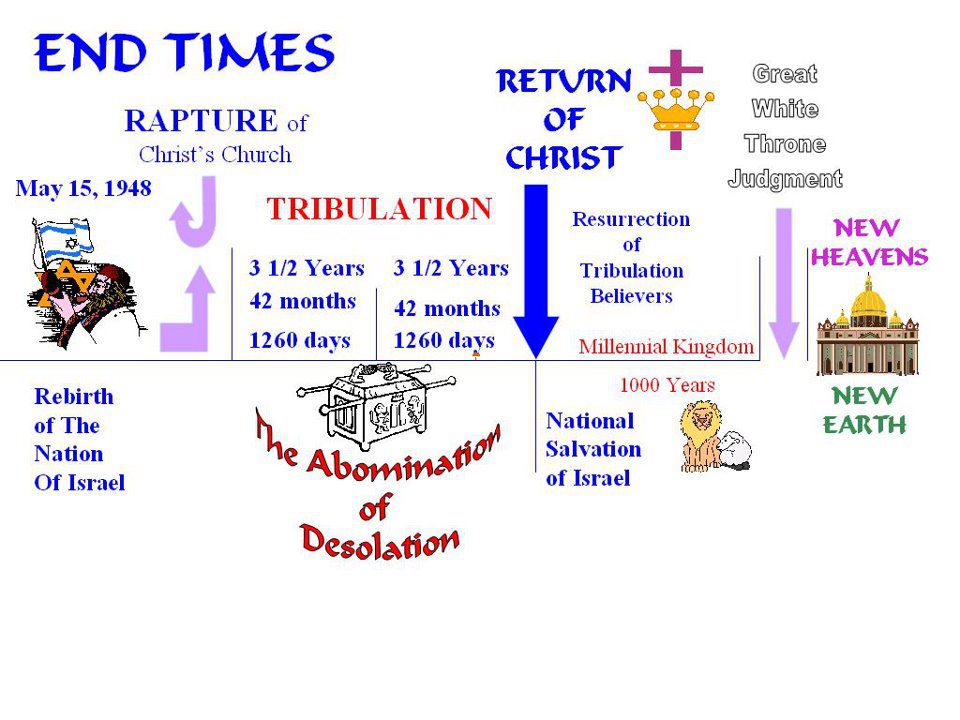
return and fight for His believing remnant (Deut. 4:26-31; Isa. 13:6-13; 17:4-11; Jer. 30:4-11; Ezek. 20:33-38; Dan. 9:27; 12:1; Zech. 14:1-4; Matt. 24:9-31).This time period begins with a covenant between Israel and the Antichrist (Dan. 9:27). The length of the Tribulation is seven years long, described in a variety of ways as “one seven” year block (Dan. 9:27), consisting of two “times, time and half a time” (two years + 1 year + half a year;Rev. 12:14),or two“1260 days” periods (Rev. 11:3), or two “42 month” periods (Rev. 11:2; 13:5).
1 Thessalonians 4:17 speaks of an event called “the Rapture”, Latin “rapio,” Greek “harpazo,” which means “to catch up, to snatch away, or to take out.”“After
that, we who are still alive and are left will be caught up together
with them in the clouds to meet the Lord in the air. And so we will be
with the Lord forever.” Paul states that the concept of the Rapture is meant to encourage believers during this Age (1 Thes. 4:18). Other references on the Rapture are Jn. 14:1-14; I Cor. 15:51-58; and 1 Thes. 4:13-18.
These bedrock
statements about the Bible and its interpretation provide the foundation
in which to analyze the followig reasons for why I believe the Bible
teaches a Pre-Tribulation Rapture of the Church.
1) The Bible describes the Rapture and Second Coming as different events.
Second Coming — Christ returns to the Mount of Olives to meet the believers on earth
Rapture — Mount of Olives is unchanged
Second Coming — Mount of Olives is divided, forming a valley east of Jerusalem
Rapture — living believers obtain glorified bodies
Second Coming — living believers remain in same bodies
Rapture — believers go to heaven
Second Coming — glorified believers come from heaven, earthly believers stay on earth
Rapture — world left unjudged and living in sin
Second Coming — world is judged and righteousness is established
Rapture — depicts deliverance of the Church from wrath
Second Coming — depicts deliverance of believers who endured wrath
Rapture — no signs precede it
Second Coming — many signs precede it
Rapture — revealed only in New Testament
Second Coming — revealed in both Old and New Testaments
Rapture — deals with only the saved
Second Coming — deals with both the saved and unsaved
Rapture — Satan remains free
Second Coming — Satan is bound and thrown into the Abyss
Since the
Rapture and Second Coming clearly are different events that do not occur
at the same time, this would rule out a Post-Tribulation Rapture
scenario.
2) The Rapture is described as occurring at any time without warning.
Jesus stated inMatthew 24:42,44
to “Therefore keep watch, because you do not know on what day your Lord
will come… So you also must be ready, because the Son of Man will come
at an hour when you do not expect him.” Not only do believers in
Christ not know when to expect Him, but the Father Himself seems to have
left Jesus out on the exact time His Son is to return. As Jesus stated
in Matthew 24:36,
“No one knows about that day or hour, not even the angels in heaven,
nor the Son, but only the Father.” These and other verses (Mat. 24:36,42,44,50; 25:13; 1 Thes. 4:18; Tit. 2:13; 1 Jn. 2:28; 3:2-3) indicate that Jesus’ arrival will come when nobody expects it.
The Second Coming, on the other hand, is preceded by many events, such as the rise of the Antichrist (Rev. 12:13-17; Zech; 13:7-9), a treaty with Israel (Dan. 9:27), the rebuilding of the Jewish Temple (Mat. 24:15; 2 Thess. 2:3-4; Rev. 11:1-2), as well as plagues and judgments and persecutions destroying most of the world’s population (Rev. 6-18).
The Book of Revelation reports these events as occurring during the
7-year Tribulation, which Revelation reveals precede the Second Coming.
Because the Rapture could happen at any moment and without warning and the Second Coming is preceded by so many signs, then the Rapture and Second Coming must be different events. The Rapture has to occur before the seven years’ worth of signs, because Christians are called to look for the Lord’s return
rather than signs such as the Antichrist’s arrival. Once the signs
begin, then the seven year countdown begins towards its end with
Christ’s return at the Second Coming.
Jesus’ imminent
return dismisses any of the other viewpoints related to a rapture that
occur within or at the end of the Tribulation.
3) The Rapture and the removal of the “Restrainer” occur at the same time.
In 2
Thessalonians, the church at Thessalonica was afraid due to a false
report that they had entered the Day of the Lord (Tribulation) and had
somehow missed the Rapture. The Apostle Paul assured them that the
Antichrist would not be revealed until a restraining force would be
taken away so that the Man of Lawlessness could be revealed.
Because the
revealing of the Antichrist coincides with the beginning of the 7-year
Tribulation starting with his peace treaty with Israel (Dan. 9:27), then the Restrainer has to be removed before the Tribulation. As the Holy Spirit also works in salvation (Jn. 16:8-11; 1 Jn. 5:7) during the Tribulation, then it is the Church that must be the Restrainer that is removed. Therefore, the Rapture and the removal of the Church must coincide, and at the beginning of the seven years.
4) The Tribulation is for Israel’s redemption.
Jeremiah 30:7describes the Tribulation as the “time of Jacob’s trouble” — “How awful that day will be! None will be like it. It will be a time of trouble for Jacob, but he will be saved out of it.”
In the Book of
Matthew, whose primary audience is the Jews, Jesus explains to his
Jewish followers what life will be like during the Tribulation. Also,
Revelation 12 describes picturesquely a woman who gives birth and has to
flee due to persecution during the Tribulation. The context shows the
woman is Israel. And again, the Battle of Armageddon is the world
against Israel. Two-thirds of the Jewish people will be killed from
these battles. These texts and others show that the Tribulation is meant
for the redemption of the Jewish people.
Why are the Jews the object of persecution during the Tribulation? For one,
Satan hates the Jewish people for giving the world the Scriptures and
the Messiah, as well as he wishes to thwart God’s promises to the Jews
(see Bedrock #4). Secondly, the Jews have to be so desperately brought low that they finally call out to their Messiah “Blessed is he who comes in the name of the Lord” (Mat. 23:39; Lk. 13:35). The Tribulation, then, is used for Israel’s redemption which also results in the punishment of the wicked. The
Church does not fit into this scenario, and are left out of the
purposes of the Tribulation. They would need to be removed — caught up —
before the Tribulation begins.
5) The Tribulation is not for the Church.
The Tribulation is God’s wrath upon the unbelieving world, and not for those who are saved from Christ’s resurrection to the Rapture — called the Church.
Yes believers have suffered all throughout human history, but there is a
special time (just like the Flood) set apart called the Day of the Lord
for God’s wrath. Christians suffering and the Tribulation/Day of the Lord are different.
True believers in Christ during the Church Age, represented by the Church of Philadelphia, are promised in Revelation 3:10,
“Since you have kept my command to endure patiently, I will also keep
you from the hour of trial that is going to come upon the whole world to
test those who live on the earth.” Paul states in 1 Thessalonians 1:10, “and to wait for his Son from heaven, whom he raised from the dead—Jesus, who rescues us from the coming wrath.” He also states in1 Thessalonians 5:9, “For God did not appoint us to suffer wrath but to receive salvation through our Lord Jesus Christ.” Romans 5:9 states, “Since we have now been justified by his blood, how much more shall we be saved from God’s wrath through him!” Ephesians 5:6 states, “Let no one deceive you with empty words, for because of such things God’s wrath comes on those who are disobedient.” Colossians 3:4states, “When Christ, who is your life, appears, then you also will appear with him in glory.” Again and again, Scripture states the Church is not meant to endure God’s wrath.
6) God’s wrath involves the whole 7-Year Tribulation.
The view that the Rapture will occur at the mid-point of the Tribulation is based upon 1 Corinthians 15:52which
states that the Rapture will occur at the blowing of “the last
trumpet.” This Mid-Tribulation Rapture view then declares this trumpet
to be the last of the seven trumpets in Revelation 11 that is blown at
the mid-point of the Tribulation. Why of the 114 references to trumpets
in the Bible these two are identified as one and the same only defies
sound Bible study. The context clearly shows the last trumpet of 1 Corinthians 15 is blown for believers whereas the seven trumpets of Revelation 8, 9 and 11 are sounded for unbelievers. The Revelation trumpets therefore can have no relevance for the Church.
The Pre-Wrath
Rapture view has the Church raptured just before the bowl judgments
(Revelation 16) that occur during the last quarter of the Tribulation.
The bowl judgments are the only judgments this view considers to be the
wrath of God, leaving the Seal and Trumpet judgments as wrath from man
and Satan. But, isn’t it Jesus Himself who breaks the seals that launch
each of the Revelation 6 seal judgments which occur at the beginning of
the Tribulation? Also, the seven angels who blow the trumpets that
initiate each of the trumpet judgments are given their trumpets at the
throne of God (Revelation 8:2). And, Revelation 15:1states that the bowl judgments at the end of the Tribulation finish the wrath of God, not begin His wrath.
Because these
judgments are initiated by Jesus Himself at the beginning of the
Tribulation, the whole Tribulation must be God’s wrath, which the Church
is exempt from.
7) The Old Testament and Revelation leave the Church out of the Tribulation.
The focus of the Tribulation — to pour out God’s wrath on the earth just like the Flood (Isa. 24:22; Zeph. 3:8; 1 Thes. 5:3; 2 Thes. 2:12) and to bring the Jewish people to accept Jesus as Messiah (Mat. 23:39; Lk. 13:35)
— is addressed by the Old Testament and the Book of Revelation to the
unbelievers and the Jewish people. In any biblical content concerning
the Tribulation/Day of the Lord, the Church cannot be found.
The whole
concept of the Church was a mystery to the Old Testament prophets. They
focused on the nation of Israel. The Book of Matthew is written to the
Jewish people, whom Jesus is addressing in Matthew 24. In the Book of
Revelation, chapters 2 and 3 cover the Church Age, but then there is no
mention of the Church until after the Tribulation/Day of the Lord
chapters 6-18. In Chapter 19, the Church returns to the texts and can be
found, not suffering, but celebrating with Christ at the Marriage
Supper of the Lamb and preparing to return with Jesus to earth.
8) The Church is busy elsewhere during the Tribulation.
While the
7-year Tribulation is occurring, the Bible records the Church will be
busy with three events. None of the three have to do with suffering on a
world being destroyed.
The first event the raptured Church will participate in is a judgment by God — the Judgment of the Just. This judgment on works is not to determine eternal destiny, but to determine degrees of reward (2 Cor. 5:10; Rev. 19:6-9).
The second event is the Marriage Supper of the Lamb.This feast celebrates the spiritual marriage of Christ’s Bride — the Church — to her Savior. Revelation 19:7-9 shares this wonderful celebration, “Let
us rejoice and be glad and give him glory! For the wedding of the Lamb
has come, and his bride has made herself ready. Fine linen, bright and
clean, was given her to wear. (Fine linen stands for the righteous acts
of the saints.) Then the angel said to me, ‘Write: ‘Blessed are those
who are invited to the wedding supper of the Lamb!’ And he added, ‘These
are the true words of God.’”
The third event
follows the Marriage Supper of the Lamb and is the Church’s preparation
to follow the King of Kings into the Battle of Armageddon at the
conclusion of the Tribulation. This event is the Second Coming of Jesus Christ (Zech. 14:1-21; Matt. 24:29-31; Mk. 13:24-27; Lk. 21:25-27; Rev. 19:11-21). Revelation 19:14identifies the Church in their “fine linen, white and clean,”
which was given to them during the first event — the Judgment of the
Just. The Church and angelic forces follow the King of Kings into His
Second Coming to the earth, but only Jesus Himself will engage in battle
and with mere words defeats the nations in siege against Jerusalem.
9) There needs to be sheep to separate from the goats.
If the Church
is raptured at the end of the Tribulation, receives their glorified
bodies, and then immediately u-turns back with Christ for the Second
Coming as the Post-Tribulation Rapture view holds, then what believer in
Christ will be available for the Sheep and Goats Judgment of Matthew 25? The only people left on earth would be unbelievers, called goats. No believer — sheep — would be available for God to put into the sheep category.
Since those who are in glorified bodies will be like the angels in that they aren’t given in marriage or reproduce (Matt. 22:30; Mk. 12:25),
then a believing, unglorified, human remnant must make it into the
sheep category and go on to produce the nations during the Millennial
reign of Christ (Ezek. 43:13-27; Isa. 19:21; Isa. 65:20-22; Rev. 20:7-10).
This would mean that people would need to come to Christ during the
Tribulation yet after the Rapture to produce this Millennial population.
10) The Bible shows God rescues the righteous from His wrath.
Being a Christian means having to endure suffering and trials at the hand of man (Jn. 16:33; Phil. 1:27; 1 Thes. 3:3; 1 Pet. 4:12-13).
But, the Bible has many examples of those who put their faith in God
are exempt from God’s wrath. Noah and his family were removed from the
Flood waters that in God’s wrath were used to judge and cleanse the
earth. Lot and his wife and two daughters were made to leave Sodom and
Gomorrah before God burned the towns up with fire and sulfur. Rahab’s
family was set apart when Joshua’s army invaded Jericho.
Could believers be miraculously protected during the Tribulation, like the Israelites were during the plagues on Egypt?
Yes, the 144,000 Jewish evangelists from Revelation 7 and 14, for
instance, will be divinely protected. But, the slaughter of believers
during the Tribulation will be so massive that they are certainly not
under any special protection (Rev. 7:9-17; 20:4).
11) The Pre-Tribulation Rapture view is not too new to discount.
Some will argue
that the Pre-Tribulation Rapture view is just “too new” to be
considered viable. Critics will point to the origin of the modern
Pre-Tribulation view and credit John Nelson Darby (1800-1882) with its
founding. But, is that assessment historically accurate? Indeed, it is
not.
The Early
Church fathers’ such as Barnabas (ca.100-105), Papias (ca. 60-130),
Justin Martyr (110-195), Irenaeus (120-202), Tertullian (145-220),
Hippolytus (ca. 185-236), Cyprian (200-250), and Lactantius (260-330)
wrote on the imminent return of Jesus Christ, the central argument for
the Pre-Tribulation Rapture view.
Biblical truth is determined by Scripture, and not how that teaching has been perceived at different times during history.
When Augustine began spiritualizing the Bible, his view of a
non-literal interpretation took hold of the church until the
Renaissance, obliterating the Premillennial and Pre-Tribulation Rapture
views in favor of Amillennialism. But, some
Medieval writers such as Ephraem of Nisibis (306-373), Abbot Ceolfrid’s
Latin Codex Amiatinus (ca. 690-716), and Brother Dolcino wrote
statements that distinguish the Rapture from the Second Coming.
When the chains
of allegorical interpretation began to fall off beginning with the
Reformation in the 1400 and 1500s, writers such as Joseph Mede
(1586-1638), Increase Mather (1639-1723), Peter Jurieu (1687), Philip
Doddridge (1738), John Gill (1748), James Macknight (1763), Thomas Scott
(1792) and Morgan Edwards (1722-1795) all wrote concerning the Rapture
occurring separate from the Second Coming. Even in the more modern
church, those like William Witherby (1818) were precursors to John Darby
in support of the view. The Pre-Tribulation Rapture view is indeed then not only biblical, but supported throughout Church history.
Closing Thoughts
I thank you for
coming down this mental journey with me concerning why I believe in the
Pre-Tribulation Rapture of the Church. Hopefully it has confirmed or
challenged some of your eschatological ideas. Bear
in mind, though, that one’s end-time views have no bearing on the
doctrine of salvation. What is to be celebrated is that our salvation
will one day lead us upwards to be with our Lord and Savior Jesus Christ
forever and ever.
When Peter came to Antioch,
I opposed him to his face, because he was clearly in the wrong. Before
certain men came from James, he used to eat with the Gentiles. But
when they arrived, he began to draw back and separate himself from the
Gentiles because he was afraid of those who belonged to the
circumcision group.
The other Jews joined him
in his hypocrisy, so that by their hypocrisy even Barnabas was led
astray. When I saw that they were not acting in line with the truth of
the gospel, I said to Peter in front of them all, “You are a Jew, yet
you live like a Gentile and not like a Jew. How is it, then, that you
force Gentiles to follow Jewish customs?”
We who are Jews by birth
and not “Gentile sinners” know that a man is not justified by observing
the law, but by faith in Jesus Christ. So we, too, have put our faith
in Christ Jesus that we may be justified by faith in Christ and not
by observing the law, because by observing the law no one will be
justified. Galatians 2:11-16
The second is, ”That to keep the truth of Christ in His Church is even more important than to keep peace.”
I now pass on to the second lesson that we learn from Antioch. That lesson is, “That to keep Gospel truth in the Church is of even greater importance than to keep peace.”
I suppose no man knew better
the value of peace and unity than the Apostle Paul. He was the Apostle
who wrote to the Corinthians about love. He was the Apostle who said, “Live
in harmony with one another; live in peace with each other; the Lord’s
servant must not quarrel; There is one body and one Spirit–just as you
were called to one hope when you were called–one Lord, one faith, one
baptism.” He was the Apostle who said,
“I have become all things to all men so that by all possible means I
might save some” (Romans 12:16; 1 Thessalonians 5:13; Philemon 3:16;
Ephesians 4:5; 1 Corinthians 9:22). Yet see how he acts here!
He withstands Peter to the face. He publicly rebukes him. He runs the
risk of all the consequences that might follow. He takes the chance of
everything that might be said by the enemies of the Church at Antioch.
Above all, he writes it down for a perpetual memorial, that it never
might be forgotten, that, wherever the Gospel is preached throughout the
world, this public rebuke of an erring Apostle might be known and read
of all men.
Now, why did he do this?
Because he dreaded false doctrine; because he knew that a little leaven
leavens the whole lump, because he would teach us that we ought to
contend for the truth jealously, and to fear the loss of truth more than
the loss of peace.
Paul’s example is one we shall
do well to remember in the present day. Many people will put up with
anything in religion, if they may only have a quiet life. They have a
morbid dread of what they call “controversy.” They are filled with a
morbid fear of what they style, in a vague way, ”party spirit,” though
they never define clearly what party spirit is. They are possessed with
a morbid desire to keep the peace, and make all things smooth and
pleasant, even though it be at the expense of truth. So long as they
have outward calm, smoothness, stillness, and order, they seem content
to give up everything else. I believe they would have thought with Ahab
that Elijah was a troubler of Israel, and would have helped the princes
of Judah when they put Jeremiah in prison, to stop his mouth. I have
no doubt that many of these men of whom I speak, would have thought that
Paul at Antioch was a very imprudent man, and that he went too far!
I
believe this is all wrong. We have no right to expect anything but
the pure Gospel of Christ, unmixed and unadulterated; the same Gospel
that was taught by the Apostles; to do good to the souls of men. I
believe that to maintain this pure truth in the Church men should be
ready to make any sacrifice, to hazard peace, to risk dissension, and
run the chance of division. They should no more tolerate false doctrine
than they would tolerate sin. They should withstand any adding to or taking away from the simple message of the Gospel of Christ.
For the truth’s sake, our Lord
Jesus Christ denounced the Pharisees, though they sat in Moses’ seat,
and were the appointed and authorized teachers of men. “Woe
to you, teachers of the law and Pharisees, you hypocrites,” He says,
eight times over, in the twenty-third chapter of Matthew. And who shall
dare to breathe a suspicion that our Lord was wrong?
For the truth’s sake, Paul withstood and blamed Peter, though a brother. Where was the use of unity when pure doctrine was gone? And who shall dare to say he was wrong?
For the truth’s sake,
Athanasius stood out against the world to maintain the pure doctrine
about the divinity of Christ, and waged a controversy with the great
majority of the professing Church. And who shall dare to say he was
wrong?
For the truth’s sake, Luther
broke the unity of the Church in which he was born, denounced the Pope
and all his ways, and laid the foundation of a new teaching. And who
shall dare to say that Luther was wrong?
For the truth’s sake, Cranmer,
Ridley, and Latimer, the English Reformers, counseled Henry VIII and
Edward VI to separate from Rome, and to risk the consequences of
division. And who shall dare to say that they were wrong?
For the truth’s sake,
Whitefield and Wesley, a hundred years ago, denounced the mere barren
moral preaching of the clergy of their day, and went out into the
highways and byways to save souls, knowing well that they would be cast
out from the Church’s communion. And who shall dare to say that they
were wrong?
Yes! peace without truth is a
false peace; it is the very peace of the devil. Unity without the
Gospel is a worthless unity; it is the very unity of hell. Let us never
be ensnared by those who speak kindly of it. Let us remember the words
of our Lord Jesus Christ, “Do not suppose
that I have come to bring peace to the earth. I did not come to bring
peace, but a sword” (Matthew 10:34) Let us remember the praise He gives
to one of the Churches in Revelation, “I know that you cannot tolerate
wicked men, that you have tested those who claim to be apostles but are
not, and have found them false” (Revelation 2:2). Let us remember the
blame He casts on another, “You tolerate that woman Jezebel, who calls
herself a prophetess” (Revelation 2:20). Never
let us be guilty of sacrificing any portion of truth on the altar of
peace. Let us rather be like the Jews, who, if they found any
manuscript copy of the Old Testament Scriptures incorrect in a single
letter, burned the whole copy, rather than run the risk of losing one
jot or tittle of the Word of God. Let us be content with nothing short
of the whole Gospel of Christ.
In what way are we to make
practical use of the general principles which I have just laid down? I
will give my readers one simple piece of advice. I believe it is advice
which deserves serious consideration.
I
warn then every one who loves his soul, to be very selective as to
the preaching he regularly hears, and the place of worship he
regularly attends. He who deliberately settles down under any ministry
which is positively unsound is a very unwise man. I will never hesitate
to speak my mind on this point. I know well that many think it a
shocking thing for a man to forsake his local church. I cannot see with
the eyes of such people. I draw a wide distinction between teaching which is defective and teaching which is thoroughly false; between teaching which errs on the negative side and teaching which is positively unscriptural.But
I do believe, if false doctrine is unmistakably preached in a
local church, a Christian who loves his soul is quite right in not going
to that local church. To hear unscriptural teaching fifty-two Sundays
in every year is a serious thing. It is a continual dropping of slow
poison into the mind. I think it almost impossible for a man willfully
to submit himself to it, and not be harmed.
I see in the New Testament we are plainly told to “Test
everything” and ”Hold on to the good” (1 Thessalonians 5:21). I see in
the Book of Proverbs that we are commanded to “Stop listening to
instruction, my son, and you will stray from the words of knowledge”
(Proverbs 19:27). If these
words do not justify a man in ceasing to worship at a church,
if positively false doctrine is preached in it, I do not know what
words can.
–Does any one mean to tell us that to attend your local denominational church is absolutely needful to a person’s salvation?If there is such a one, let him speak out, and give us his name.
–Does
any one mean to tell us that going to the denominational church will
save any man’s soul, if he dies unconverted and ignorant of Christ? If there is such a one, let him speak out, and give us his name.
–Does
any one mean to tell us that going to the denominational church will
teach a man anything about Christ, or conversion, or faith,
or repentance, if these subjects are hardly ever named in the
denomination church, and never properly explained?If there is such a one, let him speak out, and give us his name.
–Does
any one mean to say that a man who repents, believes in Christ,
is converted and holy, will lose his soul, because he has forsaken
his denomination and learned his religion elsewhere? If there is such a one, let him speak out, and give us his name.
For my part I abhor such
monstrous and extravagant ideas. I do not see a speck of foundation for
them in the Word of God. I trust that the number of those who
deliberately hold them is exceedingly small.
There are many churches where
the religious teaching is little better than Roman Catholicism. Ought
the congregation of such churches to sit still, be content, and take it
quietly? They ought not. And why? Because, like Paul, they ought to prefer truth to peace.
There are many churches where
the religious teaching is little better than morality. The distinctive
doctrines of Christianity are never clearly proclaimed. Plato, or
Seneca, or Confucius, could have taught almost as much. Ought the
congregation in such churches to sit still, be content, and take it
quietly? They ought not. And why? Because, like Paul, they ought to prefer truth to peace.
–I am using strong language in dealing with this part of my subject: I know it.
–I am trenching on delicate ground: I know it.
–I am handling matters which are generally let alone, and passed over in silence: I know it.
I say what I say from a sense
of duty to the Church of which I am a minister. I believe the state of
the times, and the position of the congregation require plain speaking. Souls are perishing, in many churches, in ignorance. Honest members of the church are disgusted and perplexed. This
is no time for smooth words. I am not ignorant of those magic
expressions, “order, division, schism, unity, controversy,” and
the like. I know the cramping, silencing influence which they seem
to exercise on some minds. I too have considered those expressions
calmly and deliberately, and on each of them I am prepared to speak my
mind.
(a) The denominational church is an admirable thing in theory.
Let it only be well administered, and worked by truly spiritual
ministers, and it is calculated to confer the greatest blessings on the
nation. But it is useless to expect attachment to the denomination, when the minister of the denominational church is ignorant of the Gospel or a lover of the world. In such a case we must never be surprised if men forsake their denomination, and seek truth wherever truth is to be found. If
the denominational minister does not preach the Gospel and live the
Gospel, the conditions on which he claims the attention of his
congregation are virtually violated, and his claim to be heard is at an
end. It is absurd to expect the head of a family to endanger the souls
of his children, as well as his own, for the sake of “the
denomination.” There is no mention of denominations in
the Bible, and we have no right to require men to live and die in
ignorance, in order that they may be able to say at last, ”I always attended my local denominational church.”
(b) Divisions and separations are most objectionable in religion.
They weaken the cause of true Christianity. They give occasion to the
enemies of all godliness to blaspheme. But before we blame people for
them, we must be careful that we lay the blame where it is deserved. False doctrine and heresy are even worse than schism.If
people separate themselves from teaching which is positively false and
unscriptural, they ought to be praised rather than reproved. In such
cases separation is a virtue and not a sin. It is easy to make sneering remarks about “itching ears,” and “love of excitement;”
but it is not so easy to convince a plain reader of the Bible that it
is his duty to hear false doctrine every Sunday, when by a little
exertion he can hear truth.
(c) Unity, quiet, and order among professing Christians are mighty blessings. They give strength, beauty, and efficiency to the cause of Christ. But even gold may be bought too dear. Unity which is obtained by the sacrifice of truth is worth nothing. It is not the unity which pleases God. The Church of Rome boasts loudly of a unity which does not deserve the name. It is unity which is obtained by taking
away the Bible from the people, by gagging private judgment, by
encouraging ignorance, by forbidding men to think for themselves. Like the exterminating warriors of old, the Catholic Church of Rome makes a solitude and calls it peace. There is quiet and stillness enough in the grave, but it is not the quiet of health, but of death. It was the false prophets who cried “Peace,” when there was no peace.
(d) Controversy in religion is a hateful thing,
It is hard enough to fight the devil, the world and the flesh, without
private differences in our own camp. But there is one thing which is
even worse than controversy, and that is false doctrine tolerated,
allowed, and permitted without protest or molestation. It was
controversy that won the battle of Protestant Reformation. If the views
that some men hold were correct, it is plain we never ought to have had
any Reformation at all! For the sake of
peace, we ought to have gone on worshipping the Virgin, and bowing down
to images and relics to this very day! Away with such trifling! There
are times when controversy is not only a duty but a benefit. Give me
the mighty thunderstorm rather than the deadly malaria. The one walks in darkness and poisons us in silence, and we are never safe. The other frightens and alarms for a little while. But it is soon over, and it clears the air. It is a plain Scriptural duty to “contend for the faith that was once for all entrusted to the saints” (Jude 1:3).
I am quite aware that the
things I have said are exceedingly distasteful to many minds. I believe
many are content with teaching which is not the whole truth, and fancy
it will be “all the same” in the end. I am sorry for them. I
am convinced that nothing but the whole truth is likely, as a general
rule, to do good to souls. I am satisfied that those who willfully put
up with anything short of the whole truth, will find at last that their
souls have received much damage. There are three things which men never
ought to trifle with: a little poison, a little false doctrine, and a
little sin.
I am quite aware that when a man expresses such opinions as those I have just brought forward, there are many ready to say, “He is not faithful to the Church.” I hear such accusations unmoved. The day of judgment will show who were the true friends of the Church and who were not. I
have learned in the last thirty-two years that if a minister leads a
quiet life, leaves alone the unconverted part of the world, and preaches
so as to offend none and edify none, he will be called by many “a good
pastor.”
And
I have also learned that if a man studies Scriptures,
labors continually for the conversion of souls, adheres closely to the
great principals of the Reformation, bears a faithful testimony
against Romanism, and preaches powerful, convicting sermons, he will
probably be thought a firebrand and “troubler of Israel.” Let men say
what they will. They are the truest friends of the Church who labor
most for the preservation of truth.
I lay these things before the readers of this paper, and invite their serious attention to them. I charge them never to forget that truth is of more importance to a Church than peace.
I ask them to be ready to carry out the principles I have laid down,
and to contend zealously, if needs be, for the truth. If we do this, we
shall have learned something from Antioch.
- J.C. Ryle (1816-1900) taken from: The Fallibility of Ministers.










 Posts
Posts