MARANATA !!!

MARANATA !!!
Showing posts with label Epistle to the Romans. Show all posts

Thursday, August 23, 2012

A MOMENT TO MOMENT SELF-EVALUATION


A MOMENT TO MOMENT SELF-EVALUATION 

Born again believers exist in one of two states:  they are either “filled with the Spirit” (Eph. 5:18), or they are, as Paul described it, ”carnal,” or “walking in the flesh” (1 Cor. 3:1; Gal. 5:16).  He said you can tell which of the two states you are in at any given time, by the “fruit” you are producing.  He wrote:  “This I say then, Walk in the Spirit, and ye shall not fulfill the lust of the flesh.  For the flesh lusteth against the Spirit, and the Spirit against the flesh: and these are contrary the one to the other. . . .  Now the works of the flesh are manifest, which are these:  adultery, fornication, uncleanness, lasciviousness, idolatry, witchcraft, hatred, variance, emulations, wrath, strife, seditions, heresies, envyings, murders, drunkenness, revellings, and such like. . . .  But the fruit of the Spirit is love, joy, peace, longsuffering, gentleness, goodness, faith, meekness, temperance: against such there is no law” (Gal. 5:16-23).

Paul described his personal struggle with his two natures in Romans 7:1-25.  He concluded by saying, “O wretched man that I am! who shall deliver me from the body of this death?  I thank God through Jesus Christ our Lord. So then with the mind I myself serve the law of God; but with the flesh the law of sin” (v. 24-25).  John described the state of the believer as being one of righteousness, or being one of sin (unrighteousness – 1 Jn. 1:8-10).  Notice his epistle was written to those who are said to be in a state of fellowship with other believers, and with God, Himself (1 Jn. 1:3).

James explained how a believer can guard himself against living according to his fleshly desires, and living according to the will of God.  He wrote, “But be ye doers of the word, and not hearers only, deceiving your own selves.  For if any be a hearer of the word, and not a doer, he is like unto a man beholding his natural face in a glass:  for he beholdeth himself, and goeth his way, and straightway forgetteth what manner of man he was.  But whoso looketh into the perfect law of liberty, and continueth therein, he being not a forgetful hearer, but a doer of the work, this man shall be blessed in his deed” (Jam. 1:22-25).

Believes are controlled by someone:  the Holy Spirit, or themselves! 

http://skipslighthouse.blogspot.com/2012/08/a-moment-to-moment-self-evaluation.html

Saturday, August 18, 2012

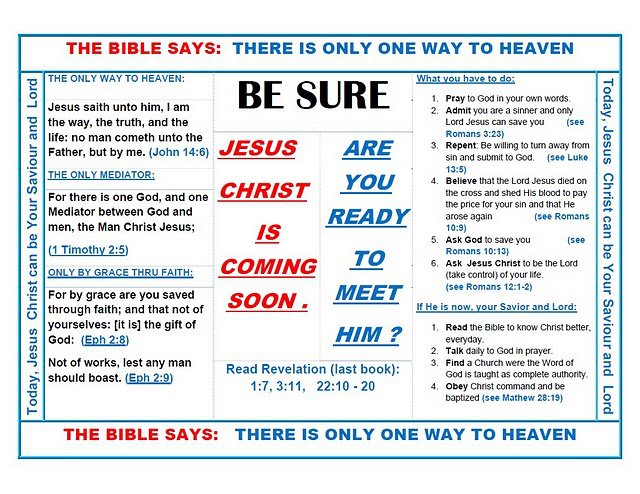
THERE IS ONLY ONE WAY TO HEAVEN-BE SURE ARE YOU READY TO MEET HIM?ARE YOU SURE?


ARE YOU TRULY SAVED FROM THE SHED BLOOD OF JESUS?ARE YOU SURE YOUR LIFE HAS BEEN TRANSFORMED BY HIS BLOOD?ARE YOU SURE YOU WILL HAVE ETERNAL LIFE AND IF YOU DIED TODAY THAT YOU WOULD GO TO HEAVEN AND LIVE WITH GOD FOREVER? ARE YOU SURE? WHY DON’T YOU TAKE THE TIME AND READ BELOW AND BE SURE OF YOUR FUTURE.GOD WANTS YOU TO BE SURE.

The Bible says;

” I have written these things to you who believe in the name of the Son of God, so that you may know that you have eternal life.” 1 John 5:13

Another question to consider is: Suppose you were standing before God right now and He asked you, ” Why should I let you into My heaven?” What do you think you would say?

You may not know what you would say. But… You can know, becauseGod loves you and has a purpose for your life. The Bible Says;” For God loved the world in this way: He gave His One and Only Son, so that everyone who believes in Him will not perish but have eternal life.” John 3:16


GOD”S PURPOSE IS THAT WE HAVE ETERNAL LIFE.* We receive eternal life as a free gift.” For the wages of sin is death, but the gift of God is eternal life in Christ Jesus our Lord.” Romans 6: 23* We can live a full and meaningful life right now.” A thief comes only to steal and to kill and to destroy. I have come that they may have life and have it in abundance. John 10:10* We will spend eternity with Jesus in Heaven.” If I go away and prepare a place for you, I will come back and receive you to Myself, so that where I am you may be also.” John 14:3

ETERNAL LIFE GIVES MEANING TO LIFE. Yet… Our sinful nature keeps us from fulfilling God’s purpose for our lives.

OUR NEED IS TO UNDERSTAND OUR PROBLEM.* We are all sinners by nature and by choice.” For all have sinned and fall short of the glory of God.” Romans 3:23* We cannot save ourselves.” not from works, so that no one can boast.” Ephesians 2:9* We deserve death.” For the wages of sin is death, but the gift of God is eternal life in Christ Jesus our Lord.” Romans 6:23It is true that: God is holy and just and must punish sin, yet He loves us and has provided forgiveness for our sin. Jesus said,” I am the way, the truth, and the life. No one comes to the Father except through Me.”The good news is that God has provided for the forgiveness of our sins.


GOD’S PROVISION IS JESUS CHRIST* Jesus is God and became man.” In the beginning was the Word, and the Word was with God, and the Word was God.” John 1:1″ The Word became flesh and took up residence among us. We observed His glory, the glory as the One and Only Son from the Father, full of grace and truth.” John 1:14 * Jesus died for us on the cross.” For Christ also suffered for sins once for all, the righteous for the unrighteous, that He might bring you to God, after being put to death in the fleshly realm but made alive in the spiritual realm.” 1 Peter 3:18 * Jesus was resurrected from the dead. Romans 4:25″He was delivered up for our trespasses and raised for our justification.”

That is good news, but the only way Jesus can affect our lives is for us to receive Him. The Bible says;” But to all who did receive Him, He gave them the right to be children of God, to those who believe in His name,” John 1:12 The choice is ours. Thus…

OUR RESPONSE IS TO RECEIVE JESUS. It is as simple as A-B-C

A.ADMIT- Admit to God that you are a sinner. Repent, turning away from your sin toward God. The Bible says in Acts 3:19;” Therefore repent and turn back, that your sins may be wiped out so that seasons of refreshing may come from the presence of the Lord,” Repentence is not just feeling sorry for our sin. Acts 26:20″ Instead, I preached to those in Damascus first, and to those in Jerusalem and in all the region of Judea, and to the Gentiles, that they should repent and turn to God, and do works worthy of repentance.”

B. BELIEVE - Believe. By faith receive Jesus Christ as God’s Son and accept Jesus’ gift of forgiveness from sin.” For by grace you are saved through faith, and this is not from yourselves; it is God’s gift–” Ephesians 2:8.* Faith is not just believing facts about Jesus.” You believe that God is one; you do well. The demons also believe–and they shudder.” James 2:19* Faith is trusting in Jesus

C. CONFESS - Confess your faith in Jesus Christ as Savior and Lord.” If we confess our sins, He is faithful and righteous to forgive us our sins and to cleanse us from all unrighteousness.” 1 John 1:9″ if you confess with your mouth, “Jesus is Lord,” and believe in your heart that God raised Him from the dead, you will be saved. With the heart one believes, resulting in righteousness, and with the mouth one confesses, resulting in salvation.” Romans 10:9-10

THREE IMPORTANT QUESTIONS:* Does what you have been reading make sense to you?* Is there any reason you would not be willing to receive God’s gift of eternal life?* Are you willing to turn from your sin and place your faith in Jesus right now? The Bible says in Romans 10:13;” For everyone who calls on the name of the Lord will be saved.”

YOU NEED TO ASK THE LORD JESUS TO SAVE YOU.Read this prayer and see if it says what you want to say to God.

” God, I know that Jesus is Your Son, and that He died on the cross and was raised from the dead. I know I have sinned and need forgiveness. I am willing to turn from my sins and turn toward You, and through faith in His death and resurrection I ask to receive Jesus as my Savior and Lord. Thank You for saving me. In Jesus name I pray, Amen.”

Call on the Lord in repentance and faith, using these or similar words of your own, and if you sincerly prayed this prayer from your heart, Jesus will become your Savior and Lord. The Master of your life.

WELCOME TO THE FAMILY OF GOD As evidence of confessing Jesus as Lord, you will want to identify with Him. The New Testament way of identification is to confess Jesus publicly and to follow Him in baptism and church membership. The Bible says in Matthew 10:32-33;” Therefore, everyone who will acknowledge Me before men, I will also acknowledge him before My Father in heaven. But whoever denies Me before men, I will also deny him before My Father in heaven.”" So those who accepted his message were baptized,” Acts 2:41″ Therefore we were buried with Him by baptism into death, in order that, just as Christ was raised from the dead by the glory of the Father, so we too may walk in a new way of life.” Romans 6:4

YOUR ASSURANCE YOU KNOW YOU HAVE ETERNAL LIFE Because…* God keeps His Promises. The Bible says in Ephesians 2: 8-9″ For by grace you are saved through faith, and this is not from yourselves; it is God’s gift– not from works, so that no one can boast.” * God heard your prayer. The Bible says in Romans 10:13;” For everyone who calls on the name of the Lord will be saved.”* God recorded your commitment. Jesus says in Luke 10:20;” However, don’t rejoice that the spirits submit to you, but rejoice that your names are written in heaven.”

GOD BLESS YOU AS A CHILD OF GOD
Praise The Lord ††† Amen!


         http://christlikeministriesnwa.wordpress.com/

Thursday, August 16, 2012

WHAT MUST I DO TO BE SAVED FROM MY SIN?


WHAT MUST I DO TO BE SAVED FROM MY SIN?

 1. BELIEVE ON THE LORD JESUS CHRIST

In Acts 16:30 the Philippian jailer asked Paul and Silas this crucial question: “What must I do to be saved?” The answer was simple and clear: “Believe on the Lord Jesus Christ and thou shalt be saved” (verse 31). The one requirement was to believe on Christ. Faith and faith alone is what God requires of a sinner.

2. FAITH ALONE IS NECESSARY FOR SALVATION

I would urge you to read carefully and prayerfully the following verses of Scripture:

John 1:12-13
John 3:15
John 3:16
John 3:18
John 3:36
John 5:24
John 6:35
John 6:40
John 6:47
John 7:38-39
John 11:25-26
John 20:31
Acts 2:21
Acts 10:43
Acts 11:17
Acts 13:38-39
Acts 15:11
Acts 16:31
Acts 20:21
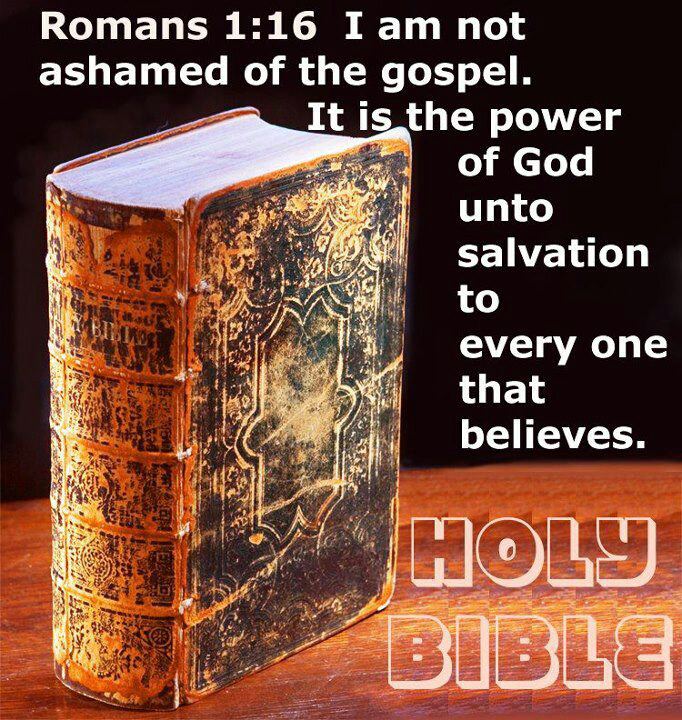
Romans 1:16
Romans 3:22
Romans 3:26
Romans 3:28
Romans 3:30
Romans 5:1
Romans 10:9
Romans 10:11
Romans 10:13
1 Corinthians 15:1-2
Galatians 2:16
Galatians 3:2-9
Galatians 3:14
Galatians 3:24
Galatians 3:26
Ephesians 2:8-9
2 Thessalonians 2:10
2 Thessalonians 2:12
1 Timothy 4:10
2 Timothy 3:15
Titus 3:8
1 John 5:1
1 John 5:11-13

In all of these passages FAITH is mentioned as being essential for salvation. Believing in Christ is the sole condition for salvation and for receiving the gift of eternal life.

3. EPHESIANS 2:8-9 TELLS US HOW A PERSON IS SAVED!

“For by grace are ye saved THROUGH FAITH, and that not of yourselves, it is the gift of God, not of works, lest any man should boast.” Salvation is a gift. It is free (paid for by the blood of Christ). All the sinner needs to do is to receive that gift by faith.

 Trust in Jesus and be saved from your sins, now, while there is still time!

Posted by at  http://skipslighthouse.blogspot.com/

Monday, July 23, 2012

DAYS OF PRAISE-WITH CHRIST-Institute for Creation Research


Days of<br />
Praise” border=”0″ hspace=”0″ /></a></p>
<h1 id= 
With Christ
July 23, 2012

 “And if children, then heirs; heirs of God, and joint-heirs with Christ; if so be that we suffer with him, that we may be also glorified together.” (Romans 8:17)

 One of the greatest doctrines of the Christian faith is the identification of Christ with His people in all the key events of His great work of salvation. For example, we are considered by God as dying with Him since He died for us. As Paul said, “I am crucified with Christ” (Galatians 2:20).

 Furthermore, when Christ was buried, we were in effect buried also. “We are buried with him by baptism into death” (Romans 6:4). Then we are also resurrected with Christ. “Buried with him in baptism, wherein also ye are risen with him through the faith of the operation of God, who hath raised him from the dead” (Colossians 2:12).

 But that is only the beginning of our great salvation. Christ then ascended to heaven, sat down on the right hand of the Father, and we are there with Him! “God, who is rich in mercy, for his great love wherewith he loved us, Even when we were dead in sins, hath quickened us together with Christ. . . . And hath raised us up together, and made us sit together in heavenly places in Christ Jesus” (Ephesians 2:4-6).

 Not even is this the end, for we are joint-heirs with Christ, as our text assures us. He has been “appointed heir of all things” (Hebrews 1:2), and we share His inheritance. “It is a faithful saying: For if we be dead with him, we shall also live with him: If we suffer, we shall also reign with him” (2 Timothy 2:11-12).

 Identified with Christ in His suffering, His death, His burial, His resurrection, His ascension, and then in His eternal reign! This is our position by faith. When He returns, it will become actuality, “and so shall we ever be with the Lord” (1 Thessalonians 4:17).

by Henry Morris, Ph.D.HMM

Institute for Creation Research| 1806 Royal Lane | Dallas | TX | 75229

  Powered by phplist.www.icr.org/change

Friday, July 20, 2012

GOT QUESTION.ORG-Question of the week: IS THERE MEANING IN TRAGEDY?


Question: “Is there meaning in tragedy?


Answer: When tragedy strikes, it is common for people to ask, “What does this mean?” When we witness some disaster or mass murder, there is a natural feeling that what has happened should not have happened. This innate sense of “wrongness” is a clue to meaning in these events. When we look to find meaning in tragedy, we must have the right perspective. We need to approach the question in a way that allows for a coherent answer, and this is only possible through a Christian worldview. Because God instills meaning into every moment and event in history, through Him we can begin to find meaning in suffering. The nature of this world lends itself to tragic events. Fortunately, God speaks to us, so that we can find not only meaning, but salvation and relief from the sufferings of the world.
When studying physical motion, it is crucial to understand perspective. Speed and acceleration are only meaningful in relation to some other object; this object is the reference point. The way in which the reference point moves affects our perception. The same is true in our sense of right and wrong. For concepts of good, bad, right, wrong, or tragedy to be meaningful, they have to be anchored to a reference point that does not change or move. The only valid reference point for these issues is God. The very fact that we consider a mass murder wrong strongly supports the idea of God as the reference point for our sense of good and evil. Without God, even the events we consider the most tragic are no more meaningful than anything else. We have to understand the nature of this world and our relationship to God in order to draw any meaning at all from the things we see.
God infuses every moment and every event with meaning and gives us confidence that He understands what we are going through. When Jesus instituted communion, He tied the past, present, and future together. 1 Corinthians 11:26 says, “For as often as you eat this bread and drink the cup (the present), you proclaim the Lord’s death (the past) until He comes (the future).” God’s knowledge of all events means nothing is insignificant to Him. If God knows when a sparrow falls, He certainly knows when we face tragedy (Matthew 10:29-31). In fact, God assured us that we would face trouble in this world (John 16:33) and that He has experienced our struggles personally (Hebrews 2:14-18; Hebrews 4:15).
While we understand that God has sovereign control over all things, it is important to remember that God is not the source of tragedy. The vast majority of human suffering is caused by sin, all too often the sin of other people. For instance, a mass murder is the fault of the murderer disobeying the moral law of God (Exodus 20:13; Romans 1:18-21). When we look to find meaning in such an event, we have to understand why this world is the way it is. The hardship of this world was originally caused by mankind’s sin (Romans 5:12), which is always a matter of choice (1 Corinthians 10:13). While God is perfectly capable of stopping tragedies before they begin, sometimes He chooses not to. While we may not know why, we do know that He is perfect, just, and holy, and so is His will. Also, the suffering we experience in this world does three things. It leads us to seek God, it develops our spiritual strength, and it increases our desire for heaven (Romans 8:18-25; James 1:2-3; Titus 2:13; 1 Peter 1:7).
In the garden of Eden, God spoke to Adam and communicated in clear and direct ways, not in abstract concepts. God speaks to us today in the same way. In some ways, this is the most important meaning to be found in any tragedy. Tragic events demonstrate much of their meaning in the way we react to them. C.S. Lewis said, “God whispers to us in our pleasures, speaks in our conscience, but shouts in our pains. It is his megaphone to rouse a deaf world.” This does not mean that God causes tragedy, but that He uses our reaction to tragedy to speak to us. Tragic events remind us not only that we live in an imperfect and fallen world, but that there is a God who loves us and wants something better for us than the world has to offer.
Recommended Resource: Is God Really in Control? Trusting God in a World of Terrorism, Tsunamis, and Personal Tragedy by Jerry Bridges.

Is God Really in Control? Trusting God in a World of Terrorism, Tsunamis, and Personal Tragedy  -<br />
        By: Jerry Bridges</p>
<p>” width=”180″ height=”180″ border=”0″ hspace=”0″ vspace=”0″ /></a></div>
<div id=


NAV Press / 2006 / Paperback
$9.49 (CBD Price)
Retail: $12.99
Save: $3.50 (27%)
Availability: In Stock
CBD Stock No: WW3931X

 There’s no more crucial topic in today’s world than understanding what God is up to in the midst of personal and global tragedy. Author Jerry Bridges helps readers answer the question “Is God in control?”, offering comfort and hope by exploring the greater purposes of God in light of Scripture.

 Publisher’s Description

From devastating natural disasters to deadly highway accidents, tragedies occur every day around the world and in our own lives. As we face death, grief, loss, we become angry and our faith is tested as we ask, “Is God really in control?” Navigator author Jerry Bridges helps answer that question positively in this topical Bible study, offering comfort and hope by exploring the greater purposes and character of God.
• Includes discussion questions
• Can be used by men, women, and teens

Author Bio

Dr. Jerry Bridges is the best-selling author of such books as The Pursuit of Holiness, The Practice of Godliness, and Transforming Grace. Jerry is on staff with The Navigators’ collegiate ministry. A popular speaker known around the world, Jerry lives with his wife, Jane, in Colorado Springs, CO.

ChristianBookPreviews.com

Where is God when life is falling apart? From Job on, people have asked this question when their souls have been in anguish. Jerry Bridges supplies answers in Bridges writes for “the average person who has not necessarily experienced major catastrophe but who does frequently encounter the typical adversities and heartaches of life”. (p. 11) Using Scripture and quoting other writers, many of them Puritan writers, Bridges grapples with the problem of understanding how a good God who is sovereign can allow, and sometimes initiate, suffering through humans, nature, and accidents.
“(I)t often seems more difficult to trust God than to obey Him….The circumstances in which we must trust God often appear irrational and unreasonable….Obeying God is worked out within well-defined boundaries of God’s revealed will. But trusting God is worked out in an arena that has no boundaries.” (p.21)
Bridges confronts questions about God’s goodness, His sovereignty, His wisdom, and our responsibility. Then he goes beyond the questions to apply Scripture to our times of hurt and confusion, helping us to accept our hardships and to grow spiritually.
His approach is very readable. He leans toward Calvinism in his acceptance of all things arising from the hand of God, and, though he does not excuse sin in human beings who bring us grief and pain, he suggests ways of dealing with our resentment, hurt, and anger against them. He promotes both recognizing God’s sovereignty and our responsibility with a good discussion of prudence. Each chapter ends with discussion questions, making it easier to use in a group setting, as well as in private study.
Jerry Bridges, a Bible teacher for the Navigators, has written several books, including the highly acclaimed The Pursuit of Holiness. Whether one fully agrees with him theologically, he addresses a thorny question thoughtfully, yet approachably. He offers much help in this short book. — Debbie W. Wilson, Christian Book Previews.com

 This bood not only teaches me to Trust God but it also backes up everything with GOD’S WORD.

Excellent commentary on the sovereignty of God.

For those who have doubts about the sovereignty of God, this is a must read. This book is an easy read yet very profound.

Christian Book Previews.com
  • Top 50 Contributor

Where is God when life is falling apart? From Job on, people have asked this question when their souls have been in anguish. Jerry Bridges supplies answers in Bridges writes for “the average person who has not necessarily experienced major catastrophe but who does frequently encounter the typical adversities and heartaches of life”. (p. 11) Using Scripture and quoting other writers, many of them Puritan writers, Bridges grapples with the problem of understanding how a good God who is sovereign can allow, and sometimes initiate, suffering through humans, nature, and accidents. (I)t often seems more difficult to trust God than to obey Him….The circumstances in which we must trust God often appear irrational and unreasonable….Obeying God is worked out within well-defined boundaries of God’s revealed will. But trusting God is worked out in an arena that has no boundaries. (p.21) Bridges confronts questions about God’s goodness, His sovereignty, His wisdom, and our responsibility. Then he goes beyond the questions to apply Scripture to our times of hurt and confusion, helping us to accept our hardships and to grow spiritually. His approach is very readable. He leans toward Calvinism in his acceptance of all things arising from the hand of God, and, though he does not excuse sin in human beings who bring us grief and pain, he suggests ways of dealing with our resentment, hurt, and anger against them. He promotes both recognizing God’s sovereignty and our responsibility with a good discussion of prudence. Each chapter ends with discussion questions, making it easier to use in a group setting, as well as in private study. Jerry Bridges, a Bible teacher for the Navigators, has written several books, including the highly acclaimed The Pursuit of Holiness. Whether one fully agrees with him theologically, he addresses a thorny question thoughtfully, yet approachably. He offers much help in this short book. — Debbie W. Wilson, Christian Book Previews

What’s new on GotQuestions.org? What is the meaning of the Parable of the Growing Seed (Mark 4:26-29)?
How can a Christian overcome the fear of witnessing?
What is anthropological hylomorphism?
Should a Christian be interested in conspiracy theories?
What is a church trustee?
What is the Feast of Trumpets?
What did Jesus mean when He said, “Today you will be with me in paradise”?
Who or what is Metatron?
What is the lust of the eyes?
What does the Bible say about discernment?


GotQuestions.org seeks to glorify the Lord Jesus Christ by providing biblical answers to spiritually-related questions. To continue in this mission, we need your support! For more information, please visit our Support Page

We apologize, but with over 178,000 QOTW subscribers, we simply cannot handle email replies to our QOTW. If you have a question about the QOTW, please submit it on our website. Thank you.

Saturday, July 7, 2012

THE DISTINGUISHING MARK OF CHRISTIANITY-John MacArthur

The Distinguishing Mark of Christianity


John MacArthur

Grace to You

JESUS IS LORD(1 Corinthians 12:3) is the distinguishing article of Christianity and marks the essential confession of faith (Romans 10:9). Jesus proclaimed it to His disciples, His enemies, and His casual inquirers alike – and He refused to tone down its implications.

The expression “Lord speaks of ownership, while “Master/Lord” (despotes) denotes an unquestionable right to command (John 13:13; Jude 4). Both words describe a master with absolute dominion over someone else. That explains Jesus’ incredulity at the practice of those who paid homage to Him with their lips but not with their lives: “Why do you call Me, ‘Lord, Lord,’ and do not do what I say?” (Luke 6:46).

Doulos frequently describes what it means to be a true Christian: “He who was called while free, is Christ’s slave [doulos]. You were bought with a price” (1 Corinthians 7:22-23). It describes the lowest, abject bond slave; his service is not a matter of choice.

A Misleading Translation

Unfortunately, readers of the English Bible have long been shielded from the full force of doulos because of an ages-old tendency to translate it as servant” or “bond-servant.” This tendency is regrettable, since service and slavery are not the same thing. “No one can be a slave to two masters” (Matthew 6:24) makes better sense than “No one can serve two masters.” An employee with two jobs could indeed serve two masters; but a slave could not. Scripture repeatedly calls Christians “slaves” (1 Corinthians 6:19-20), purchased for God (Revelation 5:9). This is the very essence of what it means to be a Christian (Romans 14:7-9).

A Revolting Concept

Not only is slave a word loaded with negative connotations, but our generation is also fixated on the concepts of freedom, fulfillment, and autonomy. Saving faith and Christian discipleship have been reduced to the cliché “a personal relationship with Jesus.” It’s hard to imagine a more disastrous twisting of what it means to be a Christian. Many people (including Judas and Satan) had some kind of “personal relationship” with Jesus during His earthly ministry without submitting to Him as Lord. But His only true friends were those who did what He said (John 15:14).

A Difficult Truth

Slavery to Christ is not a minor or secondary feature of true discipleship. It is exactly how Jesus Himself defined the “personal relationship” He must have with every true follower (John 12:26; 15:20). In fact, the fundamental aspects of slavery are the very features of redemption. We are chosen (Ephesians 1:4-5; 1 Peter 1:2; 2:9); bought (1 Corinthians 6:20; 7:23); owned (Romans 14:7-9; 1 Corinthians 6:19); subject to His will and control (Acts 5:29; Philippians 2:5-8); called to account (Romans 14:12); evaluated (2 Corinthians 5:10); and either chastened or rewarded by Him (1 Corinthians 3:14; Hebrews 12:5-11). Those are all essential components of slavery.

A Divine Introduction

Jesus introduced the NT slave metaphor. He frequently drew a direct connection between slavery and discipleship (Matthew 10:24-25). His words reflect what every true disciple should hope to hear at the end of life: “Well done, good and faithful slave. You were faithful with a few things, I will put you in charge of many things; enter into the joy of your master” (Matthew 25:21).

Jesus always described true discipleship in such terms, with no effort to adjust the message to make it sound appealing to worldly-minded sinners. He never muted what it would cost to follow Him. Would-be disciples who tried to dictate different terms were always turned away (Luke 9:59-62).

Slaves Who Are Friends

Perhaps the key passage on Jesus’ demand for implicit obedience is one already alluded to-John 15:14-15: “You are My friends if you do what I command you. No longer do I call you slaves, for the slave does not know what his master is doing; but I have called you friends, for all things that I have heard from My Father I have made known to you.”

The fundamental principle here is obedience. Jesus was not suggesting that His favor could be earned through service. Rather, He was saying that obedience is a singular proof that someone is His friend. Implicit obedience to His commandments is the natural fruit of genuine love for Him-the telltale mark of authentic, saving faith.

Why, then, does He say, “No longer do I call you slaves…I have called you friends” (v. 15)? Is He expressly telling them their relationship with Him was now a familiar, personal camaraderie between colleagues, rather than a master-slave relationship governed by authority and submission?

Not at all. The apostles were still His slaves, because that’s precisely what they were. He was simply saying they were His friends as well as His slaves. “The slave,” He explains, “does not know what his master is doing.” A slave isn’t owed any explanation or rationale. But Jesus had kept nothing secret from His disciples: “all things that I have heard from My Father I have made known to you” (v. 15). They were therefore much more than mere slaves to Him. They were His friends as well, privy to His thoughts and purposes (cf. 1 Corinthians 2:16).

Slavery and True Liberty

So understood correctly, the gospel is an invitation to slavery. On the one hand, the gospel is a proclamation of freedom to sin’s captives and liberty to people who are broken by the bondage of sin’s power over them. On the other hand, it is a summons to a whole different kind of slavery: “Having been freed from sin, you became slaves of righteousness” (Romans 6:18; cf. 1 Peter 2:16).

Both sides of the equation are vital. There is a glorious freedom in being the slaves of Christ (John 8:36), but it means the end of human autonomy for the true follower of Christ. In other words, everyone serves some master. We are all enslaved in one way or the other (Romans 6:16-21).

There is no legitimate way to adjust the message in order to make it sound appealing to people who admire Jesus but aren’t prepared to serve Him. Jesus didn’t seek admirers; He was calling followers-not casual followers, but slaves. Remove that spirit of submission, and the most profound kind of “admiration” for Christ is a spiritual fraud that has nothing to do with true faith.


Original publication date: July 8, 2009
http://www.crosswalk.com/spirituallife/11605719/page0/