Christianity can be condensed into four words: Admit, Submit, Commit and Transmit. -Samuel Wilberforce
Showing posts with label Lord Jesus. Show all posts
Showing posts with label Lord Jesus. Show all posts
Tuesday, June 30, 2015


Saturday, March 30, 2013
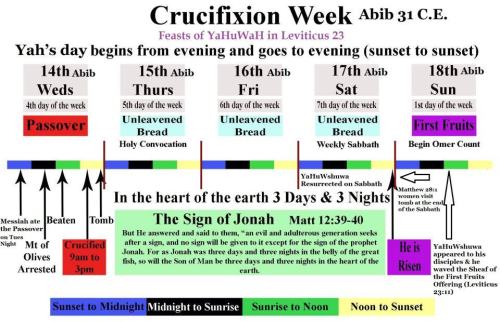
DAVE HUNT : Scripture reveals the answer OF .CRUCIFIXION WEEK
-
Question: I understand that you believe that Jesus died on the cross on Thursday, not Good Friday. Why do you say that, and does it matter?
Response: Scripture reveals the answer. Through the writings of Jeremiah, Daniel learned that the Babylonian captivity would last 70 years (Dn 9:2). God had commanded that each seven years the Hebrew slaves should be set free, debtors forgiven, and the land given a one-year sabbath of rest (Ex 21:2; Lv 25:2-4; Dt 15:1,2,12). For 490 years Israel had disobeyed this precept. In judgment, the Jews became slaves of Babylon while their land rested for 70 years of sabbaths.
Daniel confessed this sin, pondering and praying, and was given the revelation that another period of 490 years (70 weeks of years) lay ahead for his people and for Jerusalem (9:24). Then all of Israel’s sins would be purged, all prophecy fulfilled and ended, and the Messiah would reign on David’s throne in Jerusalem. These 70 weeks of years were to be counted “from the going forth of the commandment to restore and to build Jerusalem” (v. 25). That crucial date is given to us in Scripture.
Nehemiah tells us: “in the month Nisan, in the twentieth year of Artaxerxes the king” (2:1), he received the authorization to rebuild Jerusalem. When the day of the month was not given, the first day was intended. There were several Artaxerxes, but only one, Longimanus, who ruled more than 20 years—from 465-425 BC. Thus we have the key date from which this incredible prophecy was to be calculated: Nisan 1, 445 BC.
At the end of 69 of these “weeks” (7×69 = 483 years) “Messiah the Prince” would be made known to Israel (Dn 9:25) and then “be cut off [slain]” (v. 26). Counting 483 years of 360 days each (the Hebrew and Babylonian calendar), a total of 173,880 days from Nisan 1, 445 bc brings us to Sunday, April 6, ad 32. On that very day, now celebrated as Palm Sunday, Jesus rode into Jerusalem on a young donkey and was hailed as Messiah the Prince! (See also Zec:9:9)
There is, however, an even deeper meaning to the phrase, “In the fulness of time”: April 6, ad 32, on the Hebrew calendar was the tenth of Nisan. On that day, the Passover lamb was taken from the flock and placed under observation for four days to make certain that it was “without blemish.” During the same four days, Christ, whom John the Baptist had hailed as “the Lamb of God, which taketh away the sin of the world” (Jn:1:29), was likewise on display before Israel. On the fourteenth of Nisan, “the whole assembly of the congregation of Israel shall kill it [the passover lamb] in the evening [between 3:00 and 6:00 pm]” (Ex 12:6). It was during that precise time period that Jesus died on the cross!
In fact, the rabbis had determined not to arrest Jesus during Passover, “lest there be an uproar of the people” (Mk 14:2). Yet that was when He had to die. Judas was not only Satan’s pawn but God’s. Even the “thirty pieces of silver” for which he so shrewdly bargained fulfilled prophecy (Zec:11:12-13
Peter would declare in his Pentecost sermon, “Him…delivered by the determinate counsel and foreknowledge of God, ye have taken, and by wicked hands have crucified and slain” (Acts:2:23). Paul wrote, “Christ our passover [lamb] is sacrificed for us” (1 Cor:5:7).
The fourteenth of Nisan began at sunset Wednesday evening. That night, Jesus and His disciples had the “last supper” in the upper room where they were preparing to eat the Passover the following night. At this meal “ before the feast of the passover ” (Jn:13:1), Jesus told His disciples, “One of you shall betray me” (Jn:13:21). Earlier He said, significantly, “I tell you before…that, when it is come to pass, ye may believe that I am he” (Jn:13:19). The word “he” is in italics and does not appear in the original. Jesus was declaring once again to His disciples that He was Yahweh, the I AM of Israel, who tells beforehand what will happen and makes certain that it comes to pass (Is 46:9-10).
Arrested by the Judas-led troop in the Garden later that night, Christ was taken secretly to the palace of Caiaphas, the high priest. A sham trial with hastily called false witnesses convened sometime after midnight and condemned Christ to death as dawn broke. Pilate, the Roman governor, was notified of the emergency. Hurriedly taken down side streets, the prisoner was received into the citadel at “the third hour” (Mk 15:25), (about 9:00 am), Nisan 14. All over Israel preparations were underway to kill the Passover lamb, which was to be eaten that night.
Pilate let his citizens decide the prisoner’s fate. The bloodthirsty rabble turned against the One who had miraculously healed and fed so many of them. “Crucify him, crucify him” (Lk 23:21). “His blood be on us, and on our children” (Mt 27:25).
Shortly before noon, Jesus, scourged and beaten, was led out of the city to “the place of the skull.” By noon, the One whom Jerusalem, in fulfillment of prophecy, had hailed as its long-awaited Messiah, was hanging naked on the center cross between two thieves. Man had crucified his Creator!
The next three hours of that Thursday afternoon the earth was darkened mysteriously (Mt 27:45) as God “laid on him the iniquity of us all” (Is 53:6). Thursday? Not “Good Friday”? Indeed not. Jesus himself had said, “For as Jonas was three days and three nights in the whale’s belly; so shall the Son of man be three days and three nights in the heart of the earth [i.e., “Abraham’s bosom”]” (Mt 12:40; Lk 16:22). The gospel includes the declaration that Christ “rose again the third day” (1 Cor:15:4).
Had Christ been crucified on Friday, He couldn’t possibly have spent three days and three nights in the grave by Sunday morning. We are distinctly told that the angel rolled away the stone “as it began to dawn toward the first day of the week” (Mt 28:1). The tomb was already empty, so Christ must have risen from the dead sometime prior to dawn.
Wednesday, Thursday, Friday—does it really matter? Yes! The day of our Lord’s crucifixion is of the utmost importance. If Christ was not three days and three nights in the grave, then He lied. His death, to fulfill prophecy, had to occur at the very time the Passover lambs were being slain throughout Israel. It is an astronomical fact that Nisan 14, AD 32, fell on Thursday.
“And it was the preparation of the passover ….The Jews therefore…that the bodies should not remain upon the cross on the sabbath day…besought Pilate that their legs might be broken, and that they might be taken away” (Jn:19:14,31). Wait! Not a bone of the Passover lamb (Ex 12:46) or of the Messiah (Ps:34:20) could be broken. Not knowing why he did it, “one of the soldiers with a spear pierced his side” (Jn:19:34), fulfilling yet another scripture: “they shall look upon me whom they pierced” (Zec:12:10).
John explains that the “Sabbath,” which began at sunset the Thursday Christ was crucified, “was an high day.” It was, in fact, the first day of the Feast of Unleavened Bread, of which the first and last days were special sabbaths. It ended Friday at sunset, immediately followed by the weekly sabbath that ended at sunset on Saturday. Thus two sabbaths followed Christ’s death, preventing the women from coming to the grave until the third day, Sunday morning.
The rabbis thought that having Jesus crucified proved He wasn’t the Messiah. In fact, it was one more proof that He was! The soldiers took His clothes for a souvenir and gambled for His robe (Ps:22:18; 69:21); He was given vinegar mixed with gall to drink, nails were driven into His hands and feet, and a spear pierced His side, drawing forth the blood of our redemption—all in fulfillment of prophecy!

Top of Form
All that I KNOW ….is that Yeshua lived and DIED….and rose…….for my sins. HE IS.
Jesus died on Passover. Passover “day” or event changes from year to based on the Jewish month of Nisan. The Bible says that Jesus rose 3 days later. Friday to Sunday morning is not 3 days. The Edict of Milan 313 AD, Emporer Constantine and Licinius affirmed Galerius decision to legalize Christianity and hence changed our celebration of the Feasts of the Lord… specifically Passover for Christians to the pagan feast of Astarte (which became our Easter) along with Good Friday as the death instead of Passover. Jesus referred to Jonah being three days in the belly of the whale… as a type of his death. When he saiys three days, he means three days.
This is the fingerprint of God, people. Do not ignore it. If He has revealed it in His Book, then He obviously intended for us to see it, read it, understand it and be BLESSED by it.
It IS important because Jesus fulfilled the Scriptures.
http://www.torahtimes.org/pbook/default.html http://www.torahtimes.org/pbook/Review%20Of%20Michael%20Rood.pdf
http://www.torahtimes.org/pbook/Review%20Of%20Michael%20Rood.pdf
FORGIVE THEM, O MY FATHER-They know not what they do.
FORGIVE THEM, O MY FATHER-
They know not what they do.

Forgive them, O my Father,
They know not what they do.
They know not what they do.
The Savior spoke in anguish,
As sharp iron nails went through.
No word of anger spoke He
To them that shed His blood,
But prayer and tenderest pity
Large as the love of God.
For me was that compassion,
For me that tender care;
I need His wide forgiveness
As much as any there.
It was my pride and hardness
That hung Him on the tree;
Those cruel nails, O Savior,
Were driven in by me.
And often I have slighted
Thy gentle voice that said:
Forgive me too, Lord Jesus,
I knew not what I did.
O depth of sweet compassion!
O love divine and true!
Save Thou the souls that slight Thee,
And know not what they do.
Words: Cecil F. Alexander,
in Hymns Ancient and Modern, 1875, alt.
Saturday, July 14, 2012
DAYS OF PRAISE-Lukewarm Laodicea-Institute for Creation Research

Lukewarm Laodicea
July 14, 2012
“And unto the angel of the church of the Laodiceans write; . . . I know thy works, that thou art neither cold nor hot: I would thou wert cold or hot. So then because thou art lukewarm, and neither cold nor hot, I will spue thee out of my mouth.” (Revelation 3:14-16)
The Lord Jesus used intense language to rebuke this church, the last of the seven He had John write to in the book of Revelation. Laodicea was dangerously near the brink of being disavowed by He who is the Head of the church.
Such churches believe they “have need of nothing” (Revelation 3:17). Worldly wealth, extensive property, and popular recognition blinded these members and their leaders to their true spiritual condition. They failed to understand that, from the Lord’s perspective, they are “wretched, and miserable, and poor, and blind, and naked” (Revelation 3:17).
The cause of this terrible spiritual destitution is being spiritually tepid. It’s like expecting a glass of cold water or a cup of hot tea but finding everything at room temperature. This church “tasted” just like the world around them. They were neither godly nor in rebellion–just “nice people” who blended in well with the community. Their spiritual reputation did not smell either like life or death (2 Corinthians 2:16).
Despite the Lord’s distaste for such a condition, He loved and counseled them to “buy” from Him the gold of the kingdom’s true wealth, righteous clothing that would cover their shameful exposure of worldly behavior, and to anoint their spiritual eyes so that they could see eternal values rather than temporal things.
As the Lord graciously closed His letter, He “stands at the door” of the church, waiting for anyone to open and let Him in (Revelation 3:20). Tepid spirituality keeps the Lord outside. What a shame that such could ever be said about any church.
by Henry Morris III, D.Min.
Institute for Creation Research| 1806 Royal Lane | Dallas | TX | 75229
Powered by phplist. www.icr.org/change
http://www.icr.org//index.php?module=articles&action=search&f_typeID=6
Archive of Days of Praise Articles
Days of Praise | Henry Morris III, D.Min. | Jul 14, 2012
Days of Praise | Henry Morris III, D.Min. | Jul 13, 2012
Days of Praise | Henry Morris III, D.Min. | Jul 12, 2012
Days of Praise | Henry Morris III, D.Min. | Jul 11, 2012
Days of Praise | Henry Morris III, D.Min. | Jul 10, 2012
Days of Praise | Henry Morris III, D.Min. | Jul 9, 2012
Days of Praise | Henry Morris III, D.Min. | Jul 8, 2012

Monday, July 9, 2012
THE INDESCRIBABLE GIVER-Seeking the greatest blessing
THE INDESCRIBABLE GIVER
Seeking the greatest blessing

 “For God so loved the world, that He gave His only
begotten Son,that whosoever believeth in Him
should not perish,but have everlastinglife.” (Jn. 3:16)
We all know the joy a gift can bring. Children sometimes make gift lists (one of our sons once helpfully divided his list into “reasonable” and “unreasonable”) in the hopes of things to come. As we grow, our idea of the perfect gift grows with us.
At some point, however, we discover a joy greater than receiving. As the Lord Himself said:“It is more blessed to give than to receive.” (Acts 20:35b)
At first glance, this seems counter-intuitive.Surely receiving is to be
preferred! Yet, we see the truth of the Lord’s words everywhere we
look.


There are those who come into a local church with the singular desire to receive. They avoid any kind of regular commitment or service. They choose only those meetings or events which suit them. One might think—on a natural level—that they would be the happiest people in the assembly since they constantly receive and never have to give. But quite the opposite is true. They are usually among the first (and most frequent) to criticize, complain,and take offense.
If you want to find those who truly enjoy the assembly, you’ll have to look somewhere else: to those who give.
What about in the family? Again,
our age has no shortage of spouses whose primary goal in marriage is to
be on the receiving end. Sacrifice for their wife or husband isn’t high
on their priority list. They can (and do!) list the ways their spouse
should change in order to accommodate them. Requests, demands, hints,
bargains, strategies—all designed to get their own way. And yet, no matter how much they “get,” few people are more miserable.
Furthermore, the child who gets everything he wants; the child who has discovered that he can bend his parents (or his friends) to his will, provided he makes a big enough fuss—is he a happy child? Is he a blessed child? There’s a reason we call such children “spoiled.” Unless this spirit of receiving is quenched when he is young, he is in for a bleak, lonely, frustrating life.
No,
the Lord Jesus was, as always, perfectly right when He told us that
giving was the path to blessing and happiness. We understand this as
soon as we love someone. Don’t get me wrong—I’m deeply grateful for the various works of fine art that my children have made for
me over the years—treasures that will never grace the Louvre. But my
real joy is to give to them. Not necessarily in the terms of the
possessions that our society is obsessed with. There are far more
important gifts to give. But seeing their faces light up is a far
greater present than anything that comes in wrapping paper. It truly is more blessed to give than to receive.
But is even giving the greatest good? Let us take one step higher.
Above gifts, beyond giving, there is the great, incomparable Giver. “Every
good gift and every perfect gift is from above, and cometh down from
the Father of lights, with whom is no variableness, neither
shadow of turning.” (Jas. 1:17)
Nobody has ever given like He has. Think of the recipients of His gift: we give to those we love; He gave to His enemies. Or the extent of His giving: His giving never ends—He showers us with “grace upon grace” (Jn. 1:16). But eclipsing all, there is the cost of His gift—a gift that outweighs heaven and earth: His only begotten Son. A gift to fill our hearts with joy and blessing for all eternity.
“Thanks be to God for His indescribable gift!” (2 Cor। 9:15)
FROM THE EDITOR’S DESK by James Martin

UPLOOK / NOVEMBER- DECEMBER 2008
http://www.uplook.org/index.php?option=com_content&task=view&id=12&Itemid=71
http://www.uplook.org/
Sunday, July 8, 2012
DAYS OF PRAISE-FAITHFUL SMYRNA -Institute for Creation Research
Faithful Smyrna

July 9, 2012
“And unto the angel of the church in Smyrna write; . . . I know thy works, and tribulation, and poverty, (but thou art rich) . . . Fear none of those things which thou shalt suffer . . . be thou faithful unto death, and I will give thee a crown of life.” (Revelation 2:8-10)
The Lord Jesus recognized this struggling church, which is not mentioned anywhere else in the New Testament, as one of only two churches mentioned in the book of Revelation that did not receive any warning or condemnation.
He saw them very differently than our “church growth” movement might today. Many tend to envy the churches with big auditoriums or grand building programs. Most of the world praises those churches that are “emerging” from the restraints of godliness and churches that are “driven” to attract and please the ungodly.
Smyrna was poor, troubled by those who hated God’s message, and suffered tribulation for their works. Some were thrown into prison for their willingness to be identified with the truth. Generations have passed since anything like that has happened to churches in the Western world. Those countries that persecute Christians today seem only like scattered incidents that have little bearing on the day-to-day life of “civilized” nations. May God protect us from such attitudes.
But the One who walks among the “candlestick” churches of Revelation (His churches) saw Smyrna as rich and worthy of a crown of life. He praised this little church and encouraged them to remain “faithful unto death” (Revelation 2:10). When the King gives out His rewards from the great judgment seat, these faithful, poor, persecuted, troubled, and imprisoned souls will enter eternity with great riches and joyful liberty in the “general assembly and church of the firstborn” (Hebrews 12:23). HMM III
Print this article | More Days of Praise articles
Institute for Creation Research| 1806 Royal Lane | Dallas | TX | 75229Saturday, January 29, 2011
I AM TRUSTING THEE LORD JESUS -Traditional Hymns Podcast
I Am Trusting Thee, Lord Jesus
Here’s a lovely hymn about trusting the Lord Jesus. I’ve rendered four stanzas.
Lyrics: Frances R. Havergal
Music: Ethel bert W. Bull ing er
I am trusting Thee, Lord Jesus,
Trusting only Thee;
Trusting Thee for full salvation,
Great and free.
I am trusting Thee for pardon;
At Thy feet I bow;
For Thy grace and tender mercy,
Trusting now.
I am trusting Thee for cleansing
In the crimson flood;
Trusting Thee to make me holy
By Thy blood.
I am trusting Thee to guide me;
Thou alone shalt lead;
Every day and hour supplying
All my need.
I am trusting Thee for power,
Thine can never fail;
Words which Thou Thyself shalt give me
Must prevail.
I am trusting Thee, Lord Jesus;
Never let me fall;
I am trusting Thee forever,
And for all.
Subscribe to:
Posts (Atom)


 Posts
Posts