skip to main |
skip to sidebar
What is the Pretribulation Rapture?
“For the Lord himself shall
descend from heaven with a shout, with the voice of the archangel, and
with the trump of God: and the dead in Christ shall rise first: Then we
which are alive and remain shall be caught up together with them in the
clouds, to meet the Lord in the air: and so shall we ever be with the
Lord. Wherefore comfort one another with these words.” (1 Thess,
4:16-18).
“Behold, I shew you a mystery;
We shall not all sleep, but we shall all be changed, In a moment, in the
twinkling of an eye, at the last trump: for the trumpet shall sound,
and the dead shall be raised incorruptible, and we shall be changed. For
this corruptible must put on incorruption, and this mortal [must] put
on immortality” (1 Cor. 15:51-53).
The timing of the rapture is
not known. From the Word of God and from sound reasoning–something Jesus
used quite frequently–I hope to prove the reality of the pretribulation
rapture.
The word “rapture” comes from Paul’s “caught up” remark in verse 17. The words “caught up” are translated from the Greek word harpazo, which means “to carry off,” “snatch up,” or “grasp hastily.” The translation from harpazo to “rapture” involved two steps: first, harpazo became the Latin word raptus; second, raptus became the English word “rapture.”

Scriptural Evidence for the Pretribulation Rapture
The Unknown Hour
When we search the Scriptures and
read the passages describing the Lord Jesus’ return, we find verses that
tell us we won’t know the day and hour of that event. Matthew 25:13
says Jesus will return at an unknown time, while Revelation 12:6
indicates that the Jews will have to wait on the Lord 1,260 days,
starting when the Antichrist stands in the Temple of God and declares
himself to be God (2 Thes 2:4). This event will take place at the
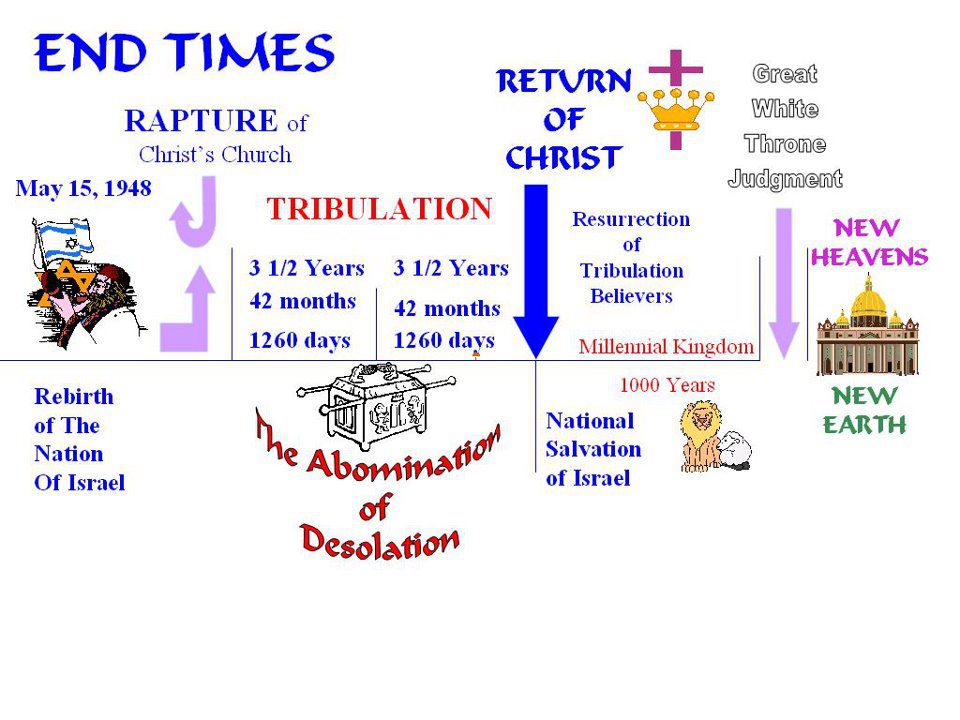
mid-point of the seven-year tribulation (Dan 9:27). Note that some
people only see a three-and-a-half-year tribulation. In a way, they are
correct because the first half of the tribulation will be relatively
peaceful compared to the second half. Nonetheless, peaceful or not,
there still remains a seven-year period called the tribulation. When the
Jews flee into the wilderness, they know that all they have to do is
wait out those 1,260 days (Mat 24:16). There is no way to apply the
phrase “neither the day nor the hour” to this situation. The only way
for these two viewpoints to be true is to separate the two distinct
events transpiring here: 1) the rapture of the Church, which comes
before the tribulation; and 2) the return of Jesus to the earth, which
takes place roughly seven years later.
The Marriage Supper of the Lamb
In Luke 12:36, the Word states
that when Christ returns, He will be returning from a wedding. In
Revelation 19:7-8, we read about the marriage itself. The marriage
supper takes place before the marriage. According to Jewish custom, the
marriage contract, which often includes a dowry, is drawn up first. The
contract parallels the act of faith we use when we trust Jesus to be our
Savior. The dowry is His life, which was used to purchase us. When it’s
time for the wedding, the groom goes to the bride’s house unannounced.
She comes out to meet him, and then he takes her to his father’s house.
This precisely correlates with the events according to the pre-trib
scenario. Jesus, the Groom, comes down from heaven and calls up the
Church, His Bride. After meeting in the air, He and His Bride return to
His Father’s house, heaven. The marriage supper itself will take place
there, while down here on earth the final events of the tribulation will
be playing out. After the marriage supper of Jewish tradition, the
bride and groom are presented to the world as man and wife. This
corresponds to the time when Jesus returns to earth accompanied by an
army “clothed in fine linen, white and clean” (Rev 19:14).
What They Didn’t Teach You in History Class
Many groups try to discredit the
pre-trib rapture by saying most of the end-time events in the Bible have
already taken place. A group of people called preterists claims that
the Book of Revelation was mostly fulfilled by 70 AD. If the events
described in the Book of Revelation took place in the past, I’m at a
loss to explain some of the current situations I see around us: the
rebirth of Israel, the reunification of Europe, the number of global
wars that have occurred, and the development of nuclear weapons. During
history class, I must have slept through the part where the teacher
talked about the time when a third of the trees were burned up,
100-pound hailstones fell from the sky, and the sea turned into blood
(Rev 8:7-8, 16:21). I think several people would have to question their
opposition to the pre-trib rapture doctrine if they knew that the
evidence provided to them was based on the understanding that most
tribulation prophecies have already occurred.
The People of the Millennium
If Christ were to come back after
the tribulation, rapture all the saints, and slay all the ungodly, who
would be left to populate the earth during the millennium? Only the
pre-trib viewpoint can account for this post-trib problem. The Church is
raptured before the tribulation, a vast number of souls are saved
during this seven-year time frame, and those who make it through the
tribulation go into the millennium while the unsaved are cast into hell.
The Saint U-Turn
In the pre-trib scenario, after we
rise to meet the Lord in the air, we will go to heaven and abide there
seven years. At the end of that period, Christ will come down to earth,
defeat the Antichrist, and cleanse the temple. In a post-trib rapture,
we would rise in the air to meet the Lord, then do a 180-degree U-turn
and come back down to earth. Revelation 1:7 states that Christ will
appear out of the clouds and come down to earth. Zechariah 14:4 says
that His feet will stand on the Mount of Olives. If He’s already headed
our way, why would we need to be caught up to meet Him?
“Come Up Hither”
Many pre-trib writers cite
Revelation 4:1, which says, “come up hither,” as a prophetic reference
to the rapture of the Church, leaving Revelation chapters 1 through 3 as
a description of the Church Age. After the shout to “come up hither,”
the Church is not mentioned in Scripture at all. The attention of
Scripture switches from the Church to the Jews living in Israel.
Armies in Fine Linen
When Jesus returns (Rev. 19:18),
an army follows Him. The army’s members are riding on white horses, and
they are clothed in fine linen that is white and clean. In Revelation
19:8, we are told that the fine linen is the righteousness of the
saints. If the saints of God are returning with Christ to wage war on
the Antichrist, then it is not possible to have a post-trib rapture
without us running into ourselves as we are coming and going.
The Time of Jacob’s Trouble
In several passages, the Bible
refers to the tribulation as a time of trouble for the Jews. The phrase
“Jacob’s trouble” pertains to the descendants of Jacob. Jeremiah 30:7
says that this time of trouble will come just before the Lord returns to
save His people. The final week of Daniel’s 70th week is yet to take
place. An angel told Daniel that, “70 weeks are determined unto thy
people” (Dan 9:24). Scripture never mentions that the tribulation is
meant to be a time of testing for Christians. However, some
post-tribbers try to claim that they are the ones being tested during
the tribulation. To make this so, they need to spiritualize the 144,000
Jewish believers in Revelation 7:2-8 who receive God’s protective seal.
Placing the Church dispensation into the same time frame as the
seven-year Jewish dispensation, as the post-tribbers do, raises one good
question: Can two dispensations transpire at the same time? In the
past, God has only dealt with one at a time. Having both present during
the tribulation would have to be an exception.
“He” That is Taken Out of the Way
Before the Antichrist can be
revealed, Paul said a certain “He” must be taken out of the way.
According to 2 Thessalonians 2:7, the “He” that must be removed is
widely thought to be the Holy Spirit. It has been promised that the Holy
Spirit would never leave the Church, and without the working of the
Holy Spirit remaining on earth, no one could be saved during the
tribulation. The removal of the Church, which is indwelt by the Holy
Ghost, would seem the best explanation for this dilemma. The working of
the Holy Spirit could go on during the tribulation, but His influence
would be diminished because of the missing Church.
War or Rapture
(Rev 19:19-21) When Jesus returns
at the end of the tribulation, He will be coming for battle. For those
who believe in a post-trib rapture, it would be strange to meet your
Lord and Savior just as He’s rushing into battle. The idea that war and
rapture could occur together is difficult to imagine, especially since
they transpire at the same moment.
The Five Foolish Virgins
The wedding story that Jesus gave
in Matthew 25:2-13, I believe, is a parable of the rapture of the
Church. It explains how some will not be ready. Jesus clearly states
that a group of people will miss out on an event, and will cry out to
God to let them into the place where He resides, heaven. Although some
try to put this parable in a post-trib context, it doesn’t fit very
well. The ones left behind in a post-trib rapture will not need to seek
the Lord because they’ll immediately be confronted by Him and His army
of angels.
God Hath Not Appointed Us to Wrath
In 1 Thessalonians 5:9, Paul
assures us that God has not appointed His people to wrath. This wrath is
plainly God’s anger that will be poured out during the tribulation.
Pre-trib believers interpret this as meaning that Christians will be
removed from the earth. Post-trib believers tell a different story. They
describe this as meaning that God will protect Christians during the
tribulation and pour this wrath out on the unbelievers only. This idea
runs against the statement made in Revelation 13:7, in which the
Antichrist is given power to make war with the saints and to overcome
them. A post-trib view would make God’s promise of protection from wrath
into a lie. In years past, it was possible to think of being protected
from the guns and swords of that day. Today, when any major war would
involve nuclear and chemical weapons, it’s impossible to expect that
same kind of protection. When Nagasaki, Japan was bombed during World
War II, the bomb exploded over a Catholic church. Everyone who was in
the center of the explosion died–both Christians and non-Christians. The
only way to validly interpret God’s promise of protection from wrath is
by viewing 1 Thessalonians 5:9 as the bodily removal of the Church from
this world.
The Salt of the Earth
Jesus said, “Ye are the salt of
the earth” (Matthew 5:13). When the believers are supenly removed, the
earth will be plunged into spiritual darkness. When this happens, the
Antichrist will then be free to control the world.
God Takes an Inventory
In Revelation 7:3, an angel
descends to earth and seals the servants of God. Two bits of information
about this sealing highly disclaim a post-trib viewpoint. The first
item is the number of people sealed: 144,000. The second one is that all
those who are sealed are from the 12 tribes of Israel. For the events
in Revelation 7:3-8 to be true in a post-trib interpretation, either the
Church has turned against God or God has turned against the Church. A
post-tribber could write a thousand-word commentary about why the Church
doesn’t need to be sealed. Instead of trying to argue about why the
Church is not mentioned or sealed, a pre-trib proponent could just say,
“We’re already in heaven.”
Noah and Lot as Examples
The tribulation period is compared
to the times of Noah and Lot by Jesus in Luke 17:28. Most people argue
over whether the time frame Jesus was talking about in that passage was
pre-trib or post-trib. In doing so, they miss an important point. The
two circumstances that the Noah and Lot situations have in common are
the removal of the righteous and the judgment of the unbelievers. From
these two accounts, we see that God prefers to remove His own when
danger is involved.
Common-Sense Reasons for Believing in the Pretribulation Rapture
The World Test
One way to check the soundness of a
doctrine is to see how the world reacts to it. One company put out a
questionnaire that was used to screen prospective employees. One of the
questions was, “Do you believe in the rapture?” If you answered “yes,”
your chances of getting hired would not be good. Some internet sites do
not allow the topics of Rapture or Second Coming. They do allow topics
such as sex, gays, and drugs. The only time the news media mentions the
rapture is when someone sets a date and is proven to be wrong.
That Old-Time Religion
It used to be a rule of thumb that
when one was visiting a church or listening to a preacher, one could
assume the preacher believed in repentance, prayer, and the baptism of
the Holy Ghost if he taught the rapture doctrine. It was also true that
the churches on fire for God worshipped out of storefronts. Today, many
of those storefront churches have moved into marble palaces and have
strayed from their principal doctrines.
Birds of a Feather Flock Together
Whenever I look at all the groups
that teach false doctrine and are highly focused on end-time events, I
cannot find any that support the rapture theory. Some organizations, the
Jehovah’s Witnesses, for example, teach a false gospel and are heavily
into Bible prophecy. Why, then, don’t Jehovah’s Witnesses teach a false
doctrine that would be right up their alley? Could it be that the
demonic forces that influence these groups know something that
Christians opposed to the rapture don’t know? The list of prophetically
minded cults that reject the idea of a rapture goes on and on. Here are
some more: the Mormons, the Worldwide Church of God and the Moonies, as
well as leaders like Jim Jones and David Koresh.
The Church Would Rebuke the Antichrist
If the Antichrist came to power
with the Church still here, I do not see how he could operate. When
Hitler was fighting to take over England, a number of Christians were
praying for victory. Hitler made mistake after mistake, and England
outperformed its enemy at every stage of the conflict. It is difficult
to measure the impact of intercessory prayer in physical warfare. Little
is known of how great a role praying saints played in the defeat of
Nazi Germany. If the Church were to reside on earth during the
tribulation, I am sure she would give the Antichrist fits. In Revelation
11:3, the two witnesses alone give the Antichrist enough headaches.
Millions of Christians who know their Bibles well would recognize the
man of sin and pray fire down on his head. The post-trib view would have
to plan on the Church just rolling over and playing dead the whole
seven years.
We should all remember one
thing: Knowing the Antichrist’s mother’s maiden name isn’t the primary
goal. Knowing Jesus Christ as your personal Savior and having your name
written in the Lamb’s Book of Life should be your number-one priority.
The jailer asked Paul, “What must I do to be saved?” The answer was,
“Believe on the Lord Jesus Christ, and thou shalt be saved” (Acts
16:30-31).
Why I Believe in a Pre-Tribulation Rapture
11 reasons why Jesus will come back before the Tribulation

Frequently I am asked to explain or defend the end-time view of the Pre-Tribulation Rapture of the Church.
For that topic, lots of Bible verses, readings and references rattle
around in my skull. I can extract each like a Powerball out of an air
machine and present it to the inquiring mind, but never in a linear,
comprehensive manner in which I particularly appreciate. And so, this
article is my attempt to organize my brain on the Pre-Tribulation
Rapture view. You’re welcome to come along on the journey!
Taking It to the Bedrock
My belief that there will be a Pre-Tribulation Rapture of the Church stands on the bedrock of the following foundational tenets:
A) The Bible is the Word of God
The
66-book canon called the Bible is God’s inerrant, infallible message to
mankind, explaining His purposes and plans for the ages (2 Tim. 3:16-17; 2 Peter 1:20-21).
No other document can be reliably trusted, nor remotely reach the bar
for the requirements of authentication that the Bible attains to so
easily.
B) The Bible is to be Interpreted Literally
God means what
He says and says what He means. God wants His creations to know His will
plainly. While God does indulge in picturesque descriptions and
parables, an explanation almost always follows or context is provided
for explanation. Spiritualization of text, therefore, has no proper
place in interpreting Scriptures. Any eschatological viewpoint must then
be thrown out if it is based on the reader’s desire to spiritualize the
Bible into whatever ethereal meaning they desire. Take the Bible for
its plain sense meaning.
C) The Church and Israel Are Separate Entities
Israel is not
the Church and the Church is not Israel. A believer in Christ becomes a
member of the Church, whether Jew or Gentile (Rom. 1:16),
but a member of the Church does not become a form of spiritual Israel.
God’s promises to Israel as a people and nation (see next tenet) are not
the same as for the Bride of Christ, the Church.
D) A Literal 1000-Year Millennium
The
Bible describes a future, literal 1000-year time period. The Greek word
“chilias” for “one thousand” appears six times in Revelation 20, clearly
marking the time period as having 1000 literal years. The purpose of
this time period is for Jesus Christ to have an earthly kingdom from
which to base His rule and to fulfill His promises (Gen. 13:14-17; 15:5,18-21; 2 Sam. 7:16-19; Isa. 10:21-22; 11:1-2; Jer. 23:5-8; 30:22; 31:31-34; Ezek. 11:18-20; 34:24; 36:24-28; Mic. 7:19-20; Hos. 3:5; Rom. 11:26-29).
E) A Literal 7-Year Tribulation
An upcoming
time period has been set aside for God to pour out His wrath upon the
evil of the world, to regather Israel back into its land, to force
Israel to acknowledge Jesus as their Messiah, and for the Messiah to
return and fight for His believing remnant (Deut. 4:26-31; Isa. 13:6-13; 17:4-11; Jer. 30:4-11; Ezek. 20:33-38; Dan. 9:27; 12:1; Zech. 14:1-4; Matt. 24:9-31). This time period begins with a covenant between Israel and the Antichrist (Dan. 9:27). The length of the Tribulation is seven years long, described in a variety of ways as “one seven” year block (Dan. 9:27), consisting of two “times, time and half a time” (two years + 1 year + half a year; Rev. 12:14), or two “1260 days” periods (Rev. 11:3), or two “42 month” periods (Rev. 11:2; 13:5).
F) Jesus Will Return Again to Earth
The Bible says Jesus will physically return again to earth (Zech. 14:1-21; Matt. 24:29-31; Mk. 13:24-27; Lk. 21:25-27; Rev. 19).
Jesus returns is to defeat His enemies, set up His throne, restore
Israel, rule with “a rod of iron” and share His authority with those who
overcame in Him (Mat. 19:28; 25:31; Acts 1:3-6; Rev. 2:26-27; 3:21).
G) The Bible Teaches About a Rapture
1 Thessalonians 4:17 speaks of an event called “the Rapture”, Latin “rapio,” Greek “harpazo,” which means “to catch up, to snatch away, or to take out.” “After
that, we who are still alive and are left will be caught up together
with them in the clouds to meet the Lord in the air. And so we will be
with the Lord forever.” Paul states that the concept of the Rapture is meant to encourage believers during this Age (1 Thes. 4:18). Other references on the Rapture are Jn. 14:1-14; I Cor. 15:51-58; and 1 Thes. 4:13-18.
These bedrock
statements about the Bible and its interpretation provide the foundation
in which to analyze the followig reasons for why I believe the Bible
teaches a Pre-Tribulation Rapture of the Church.
1) The Bible describes the Rapture and Second Coming as different events.
-
Rapture — believers meet Christ in the air
Second Coming — Christ returns to the Mount of Olives to meet the believers on earth
-
Rapture — Mount of Olives is unchanged
Second Coming — Mount of Olives is divided, forming a valley east of Jerusalem
-
Rapture — living believers obtain glorified bodies
Second Coming — living believers remain in same bodies
-
Rapture — believers go to heaven
Second Coming — glorified believers come from heaven, earthly believers stay on earth
-
Rapture — world left unjudged and living in sin
Second Coming — world is judged and righteousness is established
-
Rapture — depicts deliverance of the Church from wrath
Second Coming — depicts deliverance of believers who endured wrath
-
Rapture — no signs precede it
Second Coming — many signs precede it
-
Rapture — revealed only in New Testament
Second Coming — revealed in both Old and New Testaments
-
Rapture — deals with only the saved
Second Coming — deals with both the saved and unsaved
-
Rapture — Satan remains free
Second Coming — Satan is bound and thrown into the Abyss
Since the
Rapture and Second Coming clearly are different events that do not occur
at the same time, this would rule out a Post-Tribulation Rapture
scenario.
2) The Rapture is described as occurring at any time without warning.
Jesus stated in Matthew 24:42,44
to “Therefore keep watch, because you do not know on what day your Lord
will come… So you also must be ready, because the Son of Man will come
at an hour when you do not expect him.” Not only do believers in
Christ not know when to expect Him, but the Father Himself seems to have
left Jesus out on the exact time His Son is to return. As Jesus stated
in Matthew 24:36,
“No one knows about that day or hour, not even the angels in heaven,
nor the Son, but only the Father.” These and other verses (Mat. 24:36,42,44,50; 25:13; 1 Thes. 4:18; Tit. 2:13; 1 Jn. 2:28; 3:2-3) indicate that Jesus’ arrival will come when nobody expects it.
The Second Coming, on the other hand, is preceded by many events, such as the rise of the Antichrist (Rev. 12:13-17; Zech; 13:7-9), a treaty with Israel (Dan. 9:27), the rebuilding of the Jewish Temple (Mat. 24:15; 2 Thess. 2:3-4; Rev. 11:1-2), as well as plagues and judgments and persecutions destroying most of the world’s population (Rev. 6-18).
The Book of Revelation reports these events as occurring during the
7-year Tribulation, which Revelation reveals precede the Second Coming.
Because the Rapture could happen at any moment and without warning and the Second Coming is preceded by so many signs, then the Rapture and Second Coming must be different events. The Rapture has to occur before the seven years’ worth of signs, because Christians are called to look for the Lord’s return
rather than signs such as the Antichrist’s arrival. Once the signs
begin, then the seven year countdown begins towards its end with
Christ’s return at the Second Coming.
Jesus’ imminent
return dismisses any of the other viewpoints related to a rapture that
occur within or at the end of the Tribulation.
3) The Rapture and the removal of the “Restrainer” occur at the same time.
In 2
Thessalonians, the church at Thessalonica was afraid due to a false
report that they had entered the Day of the Lord (Tribulation) and had
somehow missed the Rapture. The Apostle Paul assured them that the
Antichrist would not be revealed until a restraining force would be
taken away so that the Man of Lawlessness could be revealed.
Because the
revealing of the Antichrist coincides with the beginning of the 7-year
Tribulation starting with his peace treaty with Israel (Dan. 9:27), then the Restrainer has to be removed before the Tribulation. As the Holy Spirit also works in salvation (Jn. 16:8-11; 1 Jn. 5:7) during the Tribulation, then it is the Church that must be the Restrainer that is removed. Therefore, the Rapture and the removal of the Church must coincide, and at the beginning of the seven years.
4) The Tribulation is for Israel’s redemption.
Jeremiah 30:7 describes the Tribulation as the “time of Jacob’s trouble” — “How awful that day will be! None will be like it. It will be a time of trouble for Jacob, but he will be saved out of it.”
In the Book of
Matthew, whose primary audience is the Jews, Jesus explains to his
Jewish followers what life will be like during the Tribulation. Also,
Revelation 12 describes picturesquely a woman who gives birth and has to
flee due to persecution during the Tribulation. The context shows the
woman is Israel. And again, the Battle of Armageddon is the world
against Israel. Two-thirds of the Jewish people will be killed from
these battles. These texts and others show that the Tribulation is meant
for the redemption of the Jewish people.
Why are the Jews the object of persecution during the Tribulation? For one,
Satan hates the Jewish people for giving the world the Scriptures and
the Messiah, as well as he wishes to thwart God’s promises to the Jews
(see Bedrock #4). Secondly, the Jews have to be so desperately brought low that they finally call out to their Messiah “Blessed is he who comes in the name of the Lord” (Mat. 23:39; Lk. 13:35). The Tribulation, then, is used for Israel’s redemption which also results in the punishment of the wicked. The
Church does not fit into this scenario, and are left out of the
purposes of the Tribulation. They would need to be removed — caught up —
before the Tribulation begins.
5) The Tribulation is not for the Church.
The Tribulation is God’s wrath upon the unbelieving world, and not for those who are saved from Christ’s resurrection to the Rapture — called the Church.
Yes believers have suffered all throughout human history, but there is a
special time (just like the Flood) set apart called the Day of the Lord
for God’s wrath. Christians suffering and the Tribulation/Day of the Lord are different.
True believers in Christ during the Church Age, represented by the Church of Philadelphia, are promised in Revelation 3:10,
“Since you have kept my command to endure patiently, I will also keep
you from the hour of trial that is going to come upon the whole world to
test those who live on the earth.” Paul states in 1 Thessalonians 1:10, “and to wait for his Son from heaven, whom he raised from the dead—Jesus, who rescues us from the coming wrath.” He also states in 1 Thessalonians 5:9, “For God did not appoint us to suffer wrath but to receive salvation through our Lord Jesus Christ.” Romans 5:9 states, “Since we have now been justified by his blood, how much more shall we be saved from God’s wrath through him!” Ephesians 5:6 states, “Let no one deceive you with empty words, for because of such things God’s wrath comes on those who are disobedient.” Colossians 3:4 states, “When Christ, who is your life, appears, then you also will appear with him in glory.” Again and again, Scripture states the Church is not meant to endure God’s wrath.
6) God’s wrath involves the whole 7-Year Tribulation.
The view that the Rapture will occur at the mid-point of the Tribulation is based upon 1 Corinthians 15:52 which
states that the Rapture will occur at the blowing of “the last
trumpet.” This Mid-Tribulation Rapture view then declares this trumpet
to be the last of the seven trumpets in Revelation 11 that is blown at
the mid-point of the Tribulation. Why of the 114 references to trumpets
in the Bible these two are identified as one and the same only defies
sound Bible study. The context clearly shows the last trumpet of 1 Corinthians 15 is blown for believers whereas the seven trumpets of Revelation 8, 9 and 11 are sounded for unbelievers. The Revelation trumpets therefore can have no relevance for the Church.
The Pre-Wrath
Rapture view has the Church raptured just before the bowl judgments
(Revelation 16) that occur during the last quarter of the Tribulation.
The bowl judgments are the only judgments this view considers to be the
wrath of God, leaving the Seal and Trumpet judgments as wrath from man
and Satan. But, isn’t it Jesus Himself who breaks the seals that launch
each of the Revelation 6 seal judgments which occur at the beginning of
the Tribulation? Also, the seven angels who blow the trumpets that
initiate each of the trumpet judgments are given their trumpets at the
throne of God (Revelation 8:2). And, Revelation 15:1 states that the bowl judgments at the end of the Tribulation finish the wrath of God, not begin His wrath.
Because these
judgments are initiated by Jesus Himself at the beginning of the
Tribulation, the whole Tribulation must be God’s wrath, which the Church
is exempt from.
7) The Old Testament and Revelation leave the Church out of the Tribulation.
The focus of the Tribulation — to pour out God’s wrath on the earth just like the Flood (Isa. 24:22; Zeph. 3:8; 1 Thes. 5:3; 2 Thes. 2:12) and to bring the Jewish people to accept Jesus as Messiah (Mat. 23:39; Lk. 13:35)
— is addressed by the Old Testament and the Book of Revelation to the
unbelievers and the Jewish people. In any biblical content concerning
the Tribulation/Day of the Lord, the Church cannot be found.
The whole
concept of the Church was a mystery to the Old Testament prophets. They
focused on the nation of Israel. The Book of Matthew is written to the
Jewish people, whom Jesus is addressing in Matthew 24. In the Book of
Revelation, chapters 2 and 3 cover the Church Age, but then there is no
mention of the Church until after the Tribulation/Day of the Lord
chapters 6-18. In Chapter 19, the Church returns to the texts and can be
found, not suffering, but celebrating with Christ at the Marriage
Supper of the Lamb and preparing to return with Jesus to earth.
8) The Church is busy elsewhere during the Tribulation.
While the
7-year Tribulation is occurring, the Bible records the Church will be
busy with three events. None of the three have to do with suffering on a
world being destroyed.
The first event the raptured Church will participate in is a judgment by God — the Judgment of the Just. This judgment on works is not to determine eternal destiny, but to determine degrees of reward (2 Cor. 5:10; Rev. 19:6-9).
The second event is the Marriage Supper of the Lamb. This feast celebrates the spiritual marriage of Christ’s Bride — the Church — to her Savior. Revelation 19:7-9 shares this wonderful celebration, “Let
us rejoice and be glad and give him glory! For the wedding of the Lamb
has come, and his bride has made herself ready. Fine linen, bright and
clean, was given her to wear. (Fine linen stands for the righteous acts
of the saints.) Then the angel said to me, ‘Write: ‘Blessed are those
who are invited to the wedding supper of the Lamb!’ And he added, ‘These
are the true words of God.’”
The third event
follows the Marriage Supper of the Lamb and is the Church’s preparation
to follow the King of Kings into the Battle of Armageddon at the
conclusion of the Tribulation. This event is the Second Coming of Jesus Christ (Zech. 14:1-21; Matt. 24:29-31; Mk. 13:24-27; Lk. 21:25-27; Rev. 19:11-21). Revelation 19:14 identifies the Church in their “fine linen, white and clean,”
which was given to them during the first event — the Judgment of the
Just. The Church and angelic forces follow the King of Kings into His
Second Coming to the earth, but only Jesus Himself will engage in battle
and with mere words defeats the nations in siege against Jerusalem.
9) There needs to be sheep to separate from the goats.
If the Church
is raptured at the end of the Tribulation, receives their glorified
bodies, and then immediately u-turns back with Christ for the Second
Coming as the Post-Tribulation Rapture view holds, then what believer in
Christ will be available for the Sheep and Goats Judgment of Matthew 25? The only people left on earth would be unbelievers, called goats. No believer — sheep — would be available for God to put into the sheep category.
Since those who are in glorified bodies will be like the angels in that they aren’t given in marriage or reproduce (Matt. 22:30; Mk. 12:25),
then a believing, unglorified, human remnant must make it into the
sheep category and go on to produce the nations during the Millennial
reign of Christ (Ezek. 43:13-27; Isa. 19:21; Isa. 65:20-22; Rev. 20:7-10).
This would mean that people would need to come to Christ during the
Tribulation yet after the Rapture to produce this Millennial population.
10) The Bible shows God rescues the righteous from His wrath.
Being a Christian means having to endure suffering and trials at the hand of man (Jn. 16:33; Phil. 1:27; 1 Thes. 3:3; 1 Pet. 4:12-13).
But, the Bible has many examples of those who put their faith in God
are exempt from God’s wrath. Noah and his family were removed from the
Flood waters that in God’s wrath were used to judge and cleanse the
earth. Lot and his wife and two daughters were made to leave Sodom and
Gomorrah before God burned the towns up with fire and sulfur. Rahab’s
family was set apart when Joshua’s army invaded Jericho.
Could believers be miraculously protected during the Tribulation, like the Israelites were during the plagues on Egypt?
Yes, the 144,000 Jewish evangelists from Revelation 7 and 14, for
instance, will be divinely protected. But, the slaughter of believers
during the Tribulation will be so massive that they are certainly not
under any special protection (Rev. 7:9-17; 20:4).
11) The Pre-Tribulation Rapture view is not too new to discount.
Some will argue
that the Pre-Tribulation Rapture view is just “too new” to be
considered viable. Critics will point to the origin of the modern
Pre-Tribulation view and credit John Nelson Darby (1800-1882) with its
founding. But, is that assessment historically accurate? Indeed, it is
not.
The Early
Church fathers’ such as Barnabas (ca.100-105), Papias (ca. 60-130),
Justin Martyr (110-195), Irenaeus (120-202), Tertullian (145-220),
Hippolytus (ca. 185-236), Cyprian (200-250), and Lactantius (260-330)
wrote on the imminent return of Jesus Christ, the central argument for
the Pre-Tribulation Rapture view.
Biblical truth is determined by Scripture, and not how that teaching has been perceived at different times during history.
When Augustine began spiritualizing the Bible, his view of a
non-literal interpretation took hold of the church until the
Renaissance, obliterating the Premillennial and Pre-Tribulation Rapture
views in favor of Amillennialism. But, some
Medieval writers such as Ephraem of Nisibis (306-373), Abbot Ceolfrid’s
Latin Codex Amiatinus (ca. 690-716), and Brother Dolcino wrote
statements that distinguish the Rapture from the Second Coming.
When the chains
of allegorical interpretation began to fall off beginning with the
Reformation in the 1400 and 1500s, writers such as Joseph Mede
(1586-1638), Increase Mather (1639-1723), Peter Jurieu (1687), Philip
Doddridge (1738), John Gill (1748), James Macknight (1763), Thomas Scott
(1792) and Morgan Edwards (1722-1795) all wrote concerning the Rapture
occurring separate from the Second Coming. Even in the more modern
church, those like William Witherby (1818) were precursors to John Darby
in support of the view. The Pre-Tribulation Rapture view is indeed then not only biblical, but supported throughout Church history.
Closing Thoughts
I thank you for
coming down this mental journey with me concerning why I believe in the
Pre-Tribulation Rapture of the Church. Hopefully it has confirmed or
challenged some of your eschatological ideas. Bear
in mind, though, that one’s end-time views have no bearing on the
doctrine of salvation. What is to be celebrated is that our salvation
will one day lead us upwards to be with our Lord and Savior Jesus Christ
forever and ever.





 Posts
Posts